
IDF Draft Rules for Dual US Citizens 2026: The Complete Legal Guide
IDF Draft Rules for Dual US Citizens 2026: The Complete Legal Guide
Imagine landing at Ben Gurion Airport for a summer wedding, only to be pulled aside by military police because you're flagged as a draft evader. With over 20,000 Americans currently serving in the IDF and mandatory service recently extended to 36 months, the stakes for dual citizens have never been higher. You probably believe your US residency or the debated H.R. 8445 bill offers a safety net, but the current IDF draft rules for dual US citizens 2026 prove that your physical freedom depends on Israeli regulations, not American proposals. It's stressful to feel like a visitor in your own homeland while fearing a legal trap at the border.
We're here to replace that uncertainty with a concrete plan. You'll gain a clear understanding of the "Bnei Mehagrim" status and learn why the failure of the US Congress to pass H.R. 8445 as of May 2026 means you must take action now. This guide provides the exact steps to regulate your military status through official channels, giving you the confidence to travel to Israel without the risk of detention. You're in good hands, and we'll ensure you navigate this complex system with professional precision.
Key Takeaways
- Identify your status as a MALSHAB and learn how the IDF applies the "Center of Life" test to determine your military eligibility.
- Navigate the updated IDF draft rules for dual US citizens 2026, including the specific "Bnei Mehagrim" criteria and strict residency limits for visits.
- Clarify the reality of US legal protections and why international legislation cannot prevent detention at the border for unregulated draft status.
- Follow a step-by-step plan to formally regulate your status (Hesderat Ma’amad) starting at age 16.5 to secure your physical freedom.
- Understand why specialized legal counsel acts as a "protective shield" when navigating the complex bureaucracy of Meitav and the military courts.
Table of Contents
-
Understanding IDF Obligations for Dual US-Israeli Citizens in 2026
-
Step-by-Step: How to Regulate Your Status (Besderat Ma’amad)
-
Why Specialized Legal Counsel is Mandatory for Dual Citizens
Understanding IDF Obligations for Dual US-Israeli Citizens in 2026
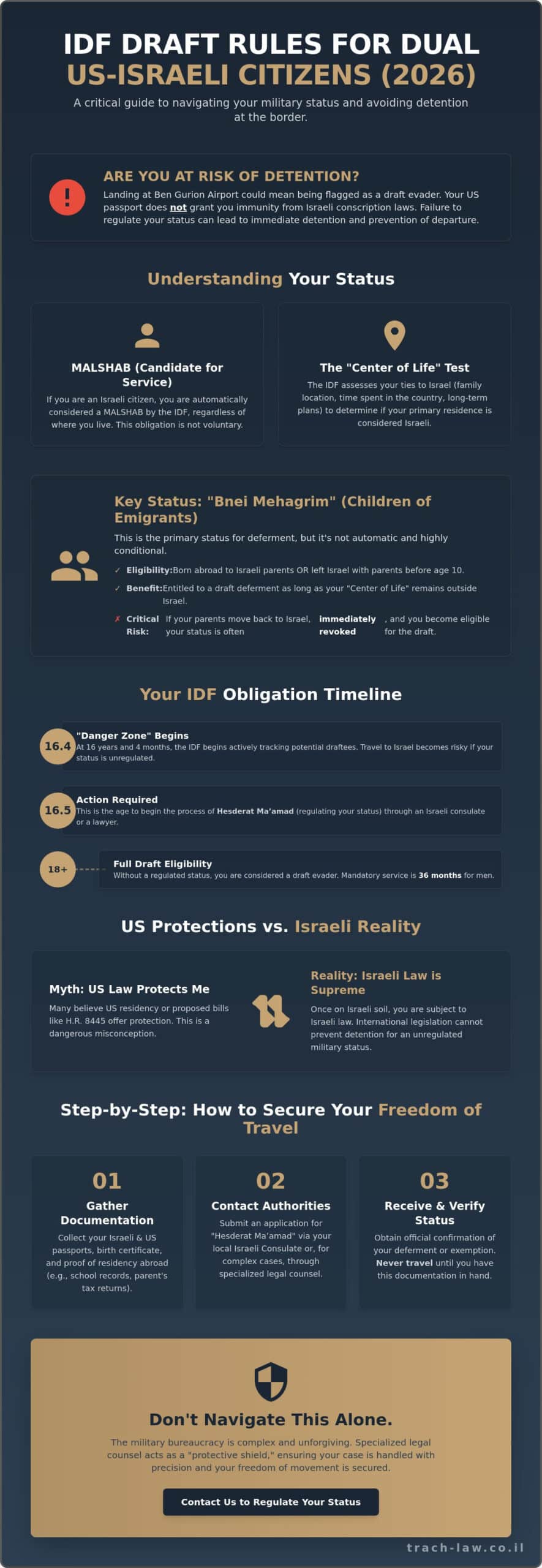
Under Israeli law, every citizen is a potential soldier from the moment they reach the age of draft eligibility. For those holding two passports, the IDF draft rules for dual US citizens 2026 are uncompromising. You are classified as a "MALSHAB," an acronym for Mועמד לשירוT ביטחון (Candidate for Military Service), regardless of whether you've ever lived in Israel or if you only visit for summer holidays. The military uses a "Center of Life" test to decide if you're a resident or a visitor. This isn't just about where you pay taxes; it's a rigorous assessment of where you spend your time, where your family is located, and your long-term intentions. If the IDF determines your center of life has shifted to Israel, your dual citizenship won't prevent a draft notice.
A common and dangerous misconception is that a blue US passport acts as a legal shield against Israeli conscription. It doesn't. If the Israeli Ministry of Interior has you registered as a citizen, you're subject to local laws the moment you touch down at Ben Gurion Airport. Bnei Mehagrim is the primary legal status for children of Israeli emigrants who were born abroad or left Israel before age 10, granting them specific rights and exemptions if handled correctly.
The Defense Service Law and You
The legal foundation for mandatory service is the Defense Service Law. This law dictates that every Israeli citizen, including those with dual US nationality, must serve. According to Israeli conscription laws, the obligation starts early. By the time a teenager reaches 16 years and 4 months, they enter the "danger zone" for travel. This is when the IDF begins tracking potential draftees. Following the July 2024 extension of mandatory service to 36 months for men, the IDF is more vigilant than ever about identifying dual citizens who haven't regulated their status. Active duty is the immediate concern, but failing to settle your paperwork can also trigger reserve obligations that haunt you for decades.
Automatic vs. Regulated Status
Your exemption or deferment is never automatic. You can't just assume the IDF knows you live in New York or Los Angeles. You must proactively file for a "regulations of status" (Besderat Ma’amad) through the Israeli Consulate or via a specialized attorney. Entering Israel on a US passport while being an unregulated Israeli citizen is a major risk. You might be detained at the airport or prevented from leaving the country until your status is resolved. This often requires professional Legal representation before the security system to clear your name and ensure your freedom of movement. The military bureaucracy is a black box. Without someone who knows the system from the inside, you're at the mercy of clerks who prioritize quotas over your personal circumstances. You're in good hands when you address these issues before the plane lands.
Specific Rules for 2026: Bnei Mehagrim and Residency Tests
The 2026 landscape for military service is defined by a "Draft of All" mentality. Following the June 2024 Supreme Court ruling that ended Haredi exemptions, the IDF has aggressively expanded its reach to fill manpower gaps. For dual nationals, this means the IDF draft rules for dual US citizens 2026 are applied with zero margin for error. The most critical status for you to understand is "Bnei Mehagrim" (Children of Emigrants). To qualify, you must have either been born abroad or left Israel with your parents before the age of 10. If you meet these criteria, you're generally entitled to a deferment, but this status is fragile. It depends entirely on your residency staying outside of Israel.
Your exemption isn't just about where you live; it's about where your parents are. If your parents decide to move back to Israel, your "Bnei Mehagrim" status is often revoked immediately. The IDF views the family unit as a single entity regarding residency. If the "center of the family" returns to the Holy Land, the military expects the children to follow suit and serve their 36 months of mandatory duty. If you're unsure how your family's recent moves affect your standing, it's wise to consult with a legal expert before booking your next flight.
The "Center of Life" Calculation
The IDF uses a sophisticated tracking system at Ben Gurion Airport to monitor every entry and exit. To maintain your exemption, you must adhere to the "Year of Residence" rule. Generally, you can visit Israel for up to 120 days per calendar year without losing your status. If you exceed this limit, you've committed a "breach of residency." The computer system flags you as a resident, and you could be blocked from departing the country. U.S. State Department guidance for dual citizens specifically warns that American-Israeli citizens may be prohibited from leaving until their service obligations are met. Special exceptions exist for "Gap Year" programs or recognized university studies, but these must be pre-approved by Meitav (the IDF induction center) to avoid legal complications.
Children of Immigrants vs. Children of Emigrants
-
Children of Emigrants (Bnei Mehagrim): Born abroad or left Israel before age 10. They enjoy the most protections.
-
Children of Immigrants: Those who moved to Israel as minors and then left. Their service obligation is often calculated based on the age they arrived in Israel.
-
Bnei Shalichim: Children of diplomats or official emissaries. They are almost always considered Israeli residents, regardless of how many years they spent in Washington or New York.
As of May 2026, the IDF has also tightened policies on academic deferments. While you can study in the US, you must provide proof of enrollment every single year. Failure to submit a simple document can result in an "Order 12" (a warrant for arrest) being issued in your name. We've seen many cases where a simple administrative oversight turned a family visit into a legal nightmare. Don't leave your freedom to chance.
US Protections vs. Israeli Reality: The H.R. 8445 Debate
The debate surrounding H.R. 8445, originally introduced in May 2024, has created a dangerous fog of misinformation for dual nationals. While the bill aimed to extend SCRA and USERRA protections to Americans serving in the IDF, it remains stalled in subcommittees as of May 2026. Even if this legislation were active, it would only offer financial and employment safeguards within the United States. It doesn't, and cannot, override the IDF draft rules for dual US citizens 2026 when you're physically present in Israel. Many families mistakenly believe that being an American citizen provides "extradition protection" or a diplomatic shield against the Israeli Defense Service Law. This is a myth. The United States cannot prevent the Israeli military police from arresting a dual citizen for desertion (Arikut) once they cross the border.
Israeli sovereignty means that your US veteran benefits or "lone soldier" status in the eyes of the Pentagon won't solve a criminal desertion charge in a Tel Aviv military court. If you've been flagged as a draft evader, the only way to clear your name is through the Israeli legal system. Relying on US based legal advice that ignores the Israeli Penal Code is a recipe for disaster. The 2026 policy environment is unique because the IDF is under immense pressure to increase manpower, making them less likely to overlook dual citizens who have failed to regulate their status.
Legal Conflict: Dual Allegiance
The US State Department maintains a complex stance on dual citizens serving in foreign militaries. While it isn't illegal under US law, it can create significant hurdles for your future career. Serving in the IDF may jeopardize your eligibility for high level US security clearances. If you're planning a career in federal law enforcement or defense contracting, you need a Security Clearance legal support strategy that accounts for both nations' requirements. This friction between Washington’s civil protections and Jerusalem’s security needs requires a specialized navigator who knows the system from the inside.
The "Safe Harbor" Misconception
Many dual citizens fall into the trap of thinking they've found a "safe harbor" because they haven't been contacted by the Israeli consulate in years. US military protections are strictly financial and civil; they don't impact Israeli criminal jurisdiction. Only the IDF Manpower Directorate can grant a valid exemption or deferment that protects you from arrest. Don't let conflicting advice from US sources lead you into a trap. You need a professional who navigates the "Black Box" of Meitav to ensure your paperwork is ironclad before you travel. You're in good hands when you prioritize Israeli legal reality over American political debates.
Step-by-Step: How to Regulate Your Status (Besderat Ma’amad)
Regulating your status isn't a task you should leave for your late teens. The ideal window to initiate the Besderat Ma’amad process begins at age 16 and a half. This is when the IDF first classifies you as a potential draftee. If you wait until you're 18, you're already behind the bureaucratic curve. The IDF draft rules for dual US citizens 2026 require a proactive approach to avoid being flagged in the system. You'll need to gather a specific dossier of evidence to prove your life is firmly rooted in the United States. This includes original birth certificates, school records from age 10 through graduation, and proof of your parents' US residency, such as utility bills or tax returns. Any gap in this timeline can lead a Meitav clerk to reject your application.
Many families try to handle this through the Israeli Consulate. While the consulate acts as a bridge, they're essentially a mailroom for the military. They don't advocate for you; they simply pass along papers. Direct representation by an Israeli military lawyer allows you to bypass the standard diplomatic delays. We speak directly to the induction center (Meitav) and the Manpower Directorate to ensure your file is processed correctly. If you're already over age 18 and have never regulated your status, you're in a high risk category. You must secure professional legal guidance immediately to prevent a warrant from being issued in your name before your next trip.
Filing the Request for Deferment
The core of your application is Form 7202, the official request for deferment or exemption for citizens living abroad. Proving your "Center of Life" is in the US requires more than just a residency permit. You must demonstrate that your primary social, educational, and family ties are outside Israel. Once submitted, the approval timeline can vary from three to six months. You aren't safe until you hold the "Official Exemption" document in your hand. Never assume a verbal "it's fine" from a consulate official is enough to protect you at the border.
Emergency Situations: Already Labeled a Deserter?
There is a massive legal difference between a "Draft Evader" (Mishtamet) and a "Deserter" (Arik). A draft evader hasn't reported for their first notice; a deserter is someone the IDF considers already inducted who has failed to show up for duty. The latter carries much harsher criminal penalties under the military penal code. If you suspect you've been labeled as either, do not land in Israel. The border control computers will alert the military police immediately upon your arrival. You need a specialized strategy for Military Law and Desertion Defense to clear your name and resolve the status before you even book a flight. We work to turn these emergency situations into regulated exemptions, ensuring you can visit family without the fear of handcuffs at the airport.
Why Specialized Legal Counsel is Mandatory for Dual Citizens
Dealing with the IDF induction center, known as Meitav, often feels like entering a maze where the rules change without notice. In 2026, with the "Draft of All" policy in full swing, the margin for error for dual nationals has vanished. The Emanuel Trach Law Office provides a "Protective Shield" for dual citizens, offering more than just administrative help. We provide a strategic defense against a rigid system that often views dual citizens as just another number in a recruitment quota. Navigating the IDF draft rules for dual US citizens 2026 requires a deep understanding of the "Black Box" of the military justice system; where a single missing document can trigger an arrest warrant.
Our firm handles sensitive dual nationality cases with the highest level of discretion and expertise. We understand the nuances of maintaining a clean record in both the United States and Israel. Whether you're dealing with security clearance concerns or simple travel anxiety, having a lynchpin in the Israeli legal system is the only way to move forward with confidence. You're in good hands when you choose a representative who knows exactly which levers to pull within the military bureaucracy.
Navigating the Military Justice System
The primary advantage of specialized counsel is our ability to speak the military's language from the inside. We don't just wait for the system to act; we intervene. Legal intervention can often convert a "Deserter" status, which carries criminal weight, back into a "Bnei Mehagrim" exemption. This process requires presenting proof of residency in a way that the Manpower Directorate cannot ignore. If you suspect your status is unregulated, you should Contact Emanuel Tratch Law Office before your situation escalates into a border detention.
Peace of Mind for Families Abroad
Parents in the US often lose sleep worrying about their children being pulled aside at the airport. Our promise is simple: you're in good hands. We work to ensure your child’s future in both countries remains unblemished, protecting their ability to work, travel, and live without the shadow of a desertion charge. Before you book a flight to Israel in 2026, run through this final checklist:
-
Do you have a physical copy of your "Official Exemption" or deferment?
-
Have you verified that your total days in Israel over the last year are within the legal limit?
-
Is your "Bnei Mehagrim" status still valid following any family relocations?
-
Has an Israeli attorney confirmed that no "Order 12" arrest warrant exists in your name?
Professional status regulation isn't just a suggestion; it's the only way to guarantee your physical freedom when visiting your homeland.
If you need to regulate your military status or resolve an existing legal complication with the IDF, get in touch with עמנואל טראץ', עורך דין ונוטריון. Our office specializes in protecting the interests of dual citizens and ensuring you can travel to Israel with total peace of mind.
Secure Your Freedom of Movement Today
The landscape of military service has shifted significantly following the July 2024 service extensions and the end of Haredi exemptions. You now understand that your physical freedom at the border relies entirely on the IDF draft rules for dual US citizens 2026 and your proactive "Besderat Ma’amad" filing. Relying on US legislative debates or a US passport alone is a high risk strategy that can lead to detention at Ben Gurion Airport. By establishing your "Bnei Mehagrim" status with the help of former military justice insiders, you transform a potential legal trap into a clear path for safe travel. Our authoritative representation ensures your dual nationality is handled with the discretion it deserves.
Secure your status and travel freely—contact Emanuel Trach Law Office today. You deserve to visit your family in Israel without the shadow of a draft notice hanging over your head.
To ensure your rights are fully protected, get in touch with עמנואל טראץ', עורך דין ונוטריון. Our firm provides the specialized expertise and discrete representation required to navigate the complex intersection of Israeli and US law.
Frequently Asked Questions
Does a dual US-Israeli citizen have to serve in the IDF?
Yes, dual US-Israeli citizens are fully subject to the Defense Service Law. Your American passport doesn't override your obligations as an Israeli national. Once you reach age 16 and 4 months, the IDF draft rules for dual US citizens 2026 classify you as a candidate for service. Unless you've formally regulated your status, the military expects you to fulfill the mandatory 36-month service term.
Can I be arrested at Ben Gurion Airport for not serving in the army?
Yes, border control is synchronized with military databases to identify unregulated citizens. If you haven't secured an official deferment or exemption, you'll likely be detained by military police upon arrival. This often leads to immediate induction or criminal proceedings, even if you only intended to visit for a short period. You shouldn't risk landing without verified paperwork.
How long can a dual citizen stay in Israel without being drafted in 2026?
You can generally visit Israel for up to 120 days per calendar year while maintaining your exemption. The IDF tracks every entry and exit to ensure your "Center of Life" remains in the United States. Exceeding this time limit or moving your family back to Israel can result in your "Bnei Mehagrim" status being revoked immediately. Stay within these limits to avoid being flagged as a resident.
What is the "Bnei Mehagrim" status and how do I get it?
Bnei Mehagrim is the primary legal status for children of Israeli emigrants who were born abroad or left Israel before age 10. To secure this status, you must submit Form 7202 along with proof of US residency, such as school transcripts and tax records. It's a proactive process that should be initiated at age 16 and a half to ensure your travel remains unrestricted.
Do I lose my US citizenship if I serve in the IDF?
No, serving in a foreign military doesn't result in the automatic loss of US citizenship. The US State Department recognizes the right of dual nationals to fulfill their obligations in Israel. However, serving in the IDF can create complications for future US federal employment or high level security clearances. It's a factor you must weigh carefully if you plan a career in US defense or intelligence.
What happens if I visit Israel as a "Deserter" (Arik)?
Visiting as a deserter triggers an immediate arrest and a trial in a military court. Deserters are viewed more severely than draft evaders because they're considered soldiers who failed to report. The penalties include prison time and a permanent criminal record in Israel. You must resolve this status through legal channels before attempting to enter the country.
Can a US lawyer help me with my IDF draft status?
No, US based attorneys lack the standing and specific expertise to navigate the Israeli military justice system. You need an Israeli military lawyer who can communicate directly with Meitav and the Manpower Directorate. Only an insider who understands the "Black Box" of Israeli bureaucracy can effectively advocate for your status regulation and protect you from criminal charges.
How does the 2026 US bill H.R. 8445 affect me?
H.R. 8445 remains a US legislative proposal that provides zero protection against Israeli conscription. While it aims to offer financial relief and job protection within the US, it has no jurisdiction over the Israeli Ministry of Defense. You shouldn't rely on American bills to secure your freedom when visiting Israel. Only a regulated status through Israeli channels provides a legal guarantee.
To resolve your military status or clear any existing draft complications, get in touch with Emanuel Tratch Law Office. Our office provides the authoritative representation and discrete guidance you need to navigate the Israeli military system safely.

Article by
עמנואל טראץ', עו"ד ונוטריון
עו"ד ונוטריון עמנואל טראץ', עורך דין בעל ניסיון עשיר, חבר בלשכת עורכי הדין החל משנת 2011.
עורך דין פרטי ותיק, בעברו שימש כיועץ משפטי בחטיבה להתאמה ביטחונית בשב"כ (סיווג ביטחוני) ויועץ משפטי בתחום הפלילי והמנהלי. פועל בשוק הפרטי משנת 2013, ומייצג לקוחות פרטיים ותאגידים. בשירותו הצבאי, שירות כחוקר בכיר וראש צוות חוקרים במצ"ח ביחידה המרכזית לחקירות מיוחדות (ימל"מ).
הבהרה
המידע באתר הוא מידע כללי ואינו מידע מחייב. הזכויות המחייבות נקבעות על-פי חוק, תקנות ופסיקות בתי המשפט. השימוש במידע המופיע באתר אינו תחליף לקבלת ייעוץ או טיפול משפטי, מקצועי או אחר והסתמכות על האמור בו היא באחריות המשתמש בלבד
פנה לקבלת
ייעוץ משפטי ללא התחייבות