
Inheritance, Probate, and Estate Administration in Israel: The Complete Guide for Non-Residents N'1
Dealing with the loss of a loved one is never easy. The challenge is often compounded when the deceased left assets in Israel, while you—the heir or executor—reside in the United States or elsewhere abroad.
Many of our clients find themselves in a complex situation: they have inherited an apartment in Tel Aviv, a bank account in Jerusalem, or land in the Galilee, but they have no idea how to navigate the Hebrew-speaking bureaucracy to claim what is rightfully theirs.
The good news? You generally do not need to fly to Israel to resolve these matters.
The reality? You do need a strategic legal partner on the ground to navigate the Israeli Registrar of Inheritance, the banks, and the Tax Authority.
At Emanuel Trach Law Office, we specialize in bridging the gap between Israeli law and international clients. This guide will walk you through everything you need to know about inheritance and probate in Israel as a non-resident.
1. Does Israeli Law Apply to Me?
The first question many US clients ask is: "My father was a US citizen who died in New York. Why do I need an Israeli probate order?"
According to private international law, the jurisdiction over assets is determined by their location (Lex Situs). Therefore:
-
Real Estate: If the deceased owned property in Israel (an apartment, land, or commercial space), Israeli law governs the transfer of that property, regardless of where the deceased lived or died.
-
Bank Accounts: Israeli banks will not release funds based on a US Probate Order alone. They require an order issued by an Israeli court or Registrar.
Even if you have a valid Will probated in the US, it has no direct legal standing in Israel until it goes through a specific validation process within the Israeli legal system.
2. The Two Main Paths: "Tzav Yerusha" vs. "Tzav Kiyum Tzavaa"
In Israel, the process of claiming an estate falls into one of two categories. Understanding the difference is the first step.
A. Succession Order (Tzav Yerusha) – When There is No Will
If the deceased did not leave a valid Will, the estate is distributed according to the Israeli Inheritance Law of 1965. This is called "Intestate Succession."
Unlike some US states where the spouse might inherit everything, in Israel, the default distribution is generally:
-
The Spouse: Receives 50% of the estate (and usually the car and household contents).
-
The Children: Share the remaining 50% equally.
If there is no spouse or children, the law dictates a specific hierarchy of heirs (parents, siblings, etc.). To claim these assets, we must file a request for a Succession Order.
B. Probate Order (Tzav Kiyum Tzavaa) – When There is a Will
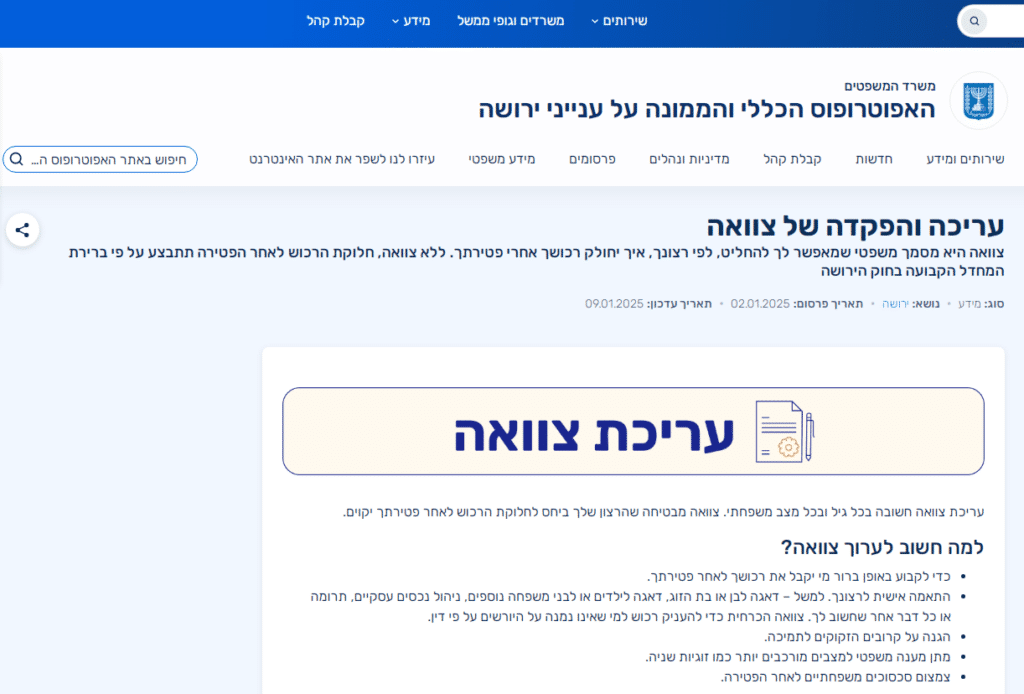
If the deceased left a Will, we must apply for a Probate Order to validate it. The Will overrides the default law (with very few exceptions), assuming it is legally valid.
Important Note for Foreign Wills:
If the Will was drafted in the US (in English) and complies with US law, it is generally valid in Israel. However, because it is a "Foreign Will," the procedural requirements are stricter (see Section 4 below).
3. The Process: Step-by-Step Timeline
While every case is unique, the standard procedure for non-residents involves the following stages. At Emanuel Trach Law Office, we handle this entire workflow for you remotely.
Step 1: Document Gathering
We will need to collect specific documents. Since you are abroad, some of these will need an Apostille (an international authentication stamp).
-
Original Death Certificate (with Apostille).
-
Original Will (if it exists).
-
List of heirs and their details.
-
Power of Attorney signed by you (we can facilitate this via the Israeli Consulate or a local Notary with an Apostille).
Step 2: Filing the Application
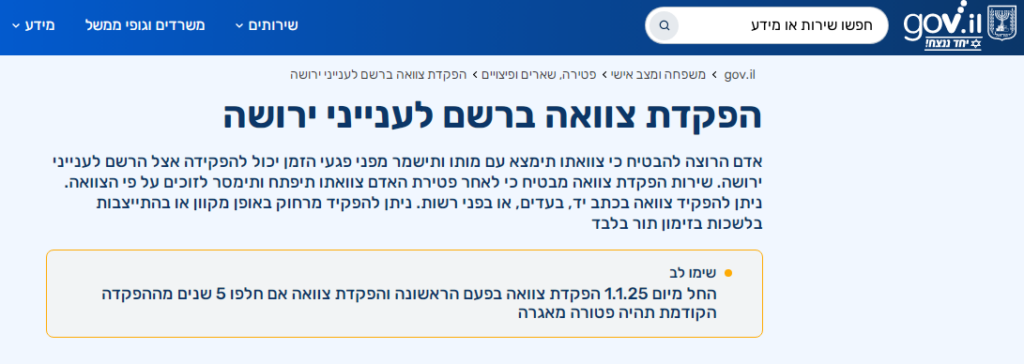
We submit the application to the Registrar of Inheritance Affairs (Rasham HaYerusha). In cases involving foreign residents, the file is sometimes automatically transferred to the Family Court, though recent reforms have streamlined this.
Step 3: Publication
By law, notice of the application must be published in a daily Israeli newspaper and the Official Gazette (Yalkut HaPirsumim). This allows potential objectors (e.g., a secret creditor or a hidden heir) a window of time to come forward—usually 14 days.
Step 4: Examination and State Attorney Response
The file is reviewed by the Registrar’s legal team. Because the deceased or heirs are foreign residents, the file is often sent to the Representative of the Attorney General to ensure no state interests are harmed. This "bureaucratic loop" is where many files get stuck without proactive legal follow-up.
Step 5: Issuance of the Order
Once approved, the Registrar issues the digital Order. This document is the "Key" that unlocks the assets.
4. The Challenge of Foreign Wills (Section 136-140)
This is the most critical section for US clients.
Under Section 136-140 of the Israeli Inheritance Law, a court may uphold a Will that is valid under the laws of the country where it was made (e.g., New York or Florida law), even if it doesn't meet specific Israeli technicalities.
However, to prove this to the Israeli judge, we often need to submit a Legal Opinion on Foreign Law.
-
What is it? An expert affidavit explaining to the Israeli court that the Will is valid according to the laws of the state where the deceased resided.
-
Do you need it? Not always, but frequently. Our office can advise if this is necessary for your specific case and draft the required legal opinions.
5. Israeli Estate Taxes: The Good and The Bad
One of the first questions we receive is: "How much of the inheritance will the Israeli government take?"
The Good News: No "Death Tax"
Israel abolished the Estate Tax (Death Tax) in 1981. This means you do not pay a percentage of the estate's value to the Israeli government simply for inheriting it.
The Nuance: Capital Gains Tax (Mas Shevach)
While you don't pay tax on inheriting, you might pay tax when you eventually sell the asset (specifically real estate).
-
The "Step-Up" Rule (or lack thereof): Unlike in the US, Israel generally does not offer a "Step-Up in Basis" for real estate. The heir "steps into the shoes" of the deceased regarding the original purchase price.
-
Exemptions: However, specific exemptions exist for "Qualifying Residential Apartments." If the deceased owned only one apartment and would have been exempt from tax if they sold it themselves, the heirs might also be exempt.
Caution: For US citizens, there is a complex interaction between Israeli taxes and US IRS reporting. While we handle the Israeli side, we strongly recommend consulting with a US CPA regarding the implications of the inheritance on your US tax return.
6. Navigating Israeli Banks: A Hurdle for Americans
Inheriting a bank account in Israel can be more difficult than inheriting real estate. Since the passing of FATCA (Foreign Account Tax Compliance Act), Israeli banks are extremely strict with US citizens.
Common obstacles include:
-
Frozen Accounts: Upon notification of death, the bank freezes the account immediately. No standing orders or bills are paid.
-
The "In-Person" Requirement: Banks often demand the heir show up physically to identify themselves.
-
Compliance Forms: Endless W-9 forms and anti-money laundering declarations.
How We Help:
Emanuel Trach Law Office has extensive experience dealing with bank compliance departments. We know exactly which documents to prepare to release funds to your US account or convert them to NIS/USD without requiring you to fly to Tel Aviv.
7. Real Estate: Transfer and Registration (Tabu)
Once we obtain the Probate Order, the work isn't finished. The Order declares who the heirs are, but it doesn't automatically change the title deeds.
We must manually register the inheritance at the:
-
Land Registry Bureau (Tabu): For privately owned land.
-
Israel Land Authority (Minhal): For state-leased land.
-
Housing Companies: For older properties not yet fully registered.
This step is crucial. If you intend to sell the apartment, you cannot sign a contract until the property is registered in your name (or the heirs' names).
8. Why You Need a Specialized Attorney
Trying to manage an Israeli inheritance using a generic lawyer or attempting a DIY approach from abroad often leads to:
-
Delays: Files sitting at the Registrar for months due to a missing apostille or incorrect translation.
-
Banking Deadlocks: Funds remaining stuck because the bank refuses to accept a general Power of Attorney.
-
Tax Mistakes: Selling a property without proper tax planning, resulting in unnecessary payments of tens of thousands of shekels.
Emanuel Trach Law Office offers:
-
Full English Service: Clear communication, no language barrier.
-
Remote Management: We act as your boots on the ground.
-
Holistic Approach: We handle the legal probate, the real estate registration, and the tax planning under one roof.
Frequently Asked Questions (FAQ)
Q: How long does the probate process take in Israel?
A: If there are no objections and the paperwork is perfect, it usually takes 3 to 5 months to receive the Order. If the file is transferred to Family Court or involves complex foreign law issues, it may take longer.
Q: Do I need to come to Israel to sign documents?
A: generally, no. Most documents can be signed in your home country before a local notary (with an Apostille) or at an Israeli Consulate.
Q: My parent left a debt in Israel. Am I responsible for it?
A: In Israel, heirs are liable for the estate's debts only up to the value of the assets they inherited. You generally do not have to pay the deceased's debts out of your own pocket.
Q: Can we sell the apartment before the Probate Order is issued?
A: You can sign a "conditional" sale agreement, but the deal cannot be finalized, and title cannot pass until the Order is granted and registered. This requires careful legal drafting to protect you from breach of contract.
Q: What is an Apostille and where do I get it?
A: An Apostille is an international stamp that verifies a public official's signature (like a notary). In the US, it is usually issued by the Secretary of State in the state where the document was notarized.
Take the Next Step
Don't let bureaucracy delay your family's closure. Whether you are ready to file for probate or simply have questions about a potential inheritance, we are here to provide clarity and efficiency.
Contact Emanuel Trach Law Office today for a preliminary consultation regarding your Israeli inheritance.
Contact Us / Schedule a Zoom Call
Disclaimer: The information provided in this article is for general educational purposes only and does not constitute legal advice. Inheritance laws are complex and subject to change. Always consult with a qualified Israeli attorney regarding your specific case.
Inheritance | Estate Administration in Israel | Israeli Inheritance Law | Probate in Israel | Inheriting Property in Israel | Israeli Succession Order | Israeli Lawyer for US Heirs | Inheritance for Non-Residents Israel | Foreign Will Validity Israel | Unfreezing Israeli Bank Account | Estate Administration Israel | Israeli Probate Attorney

פנה לקבלת
ייעוץ משפטי ללא התחייבות