
Israeli Army Exemption for American Students: The 2026 Guide to Ben Mehagrim Status
Israeli Army Exemption for American Students
Imagine landing at Ben Gurion Airport for a long-awaited semester in Jerusalem, only to be pulled aside by border control because your military status remains a question mark. For many, the fear of being detained or forced into unexpected service is enough to keep them away from Israel entirely. You've likely heard conflicting messages from the consulate or felt the deep anxiety of potentially losing your rights as a citizen. It's a heavy burden to carry when you just want to study or visit family. You deserve to travel with the total confidence that your legal status is ironclad and that your future is protected.
This guide explains exactly how to secure an Israeli army exemption for American students by obtaining official Ben Mehagrim recognition. You'll learn how the 120-day annual stay limit works and how to utilize the "Shnat Shehiya" for a one-time extended visit of up to 365 days. We also cover the specific 2026 regulations that require status regularization at age 16 and four months, alongside the rules allowing students who left Israel before age 10 to complete a four-year degree safely. By the end of this article, you'll have a clear path to your travel permit and the peace of mind that comes from knowing you're in good hands.
Key Takeaways
- Understand why dual citizenship doesn't grant automatic immunity and how the Israeli Security Service Law applies to you from the age of 16.
- Discover the specific legal criteria for securing an Israeli army exemption for American students through the official Ben Mehagrim status.
- Learn why leaving Israel before the age of 10 is the critical threshold for securing long-term study permissions and full military exemptions.
- Identify common traps, such as a parent’s residency in Israel, that can unexpectedly void your deferral and lead to arrest at the airport.
- See why professional representation before the Meitav authorities is essential for navigating complex cases that the consulate cannot resolve alone.
Table of Contents
-
Understanding the Israeli Military Obligation for American Students
-
Common Pitfalls and Objections: "But I am an American Student!"
-
Securing Your Future: Why Professional Legal Counsel is Essential
Understanding the Israeli Military Obligation for American Students
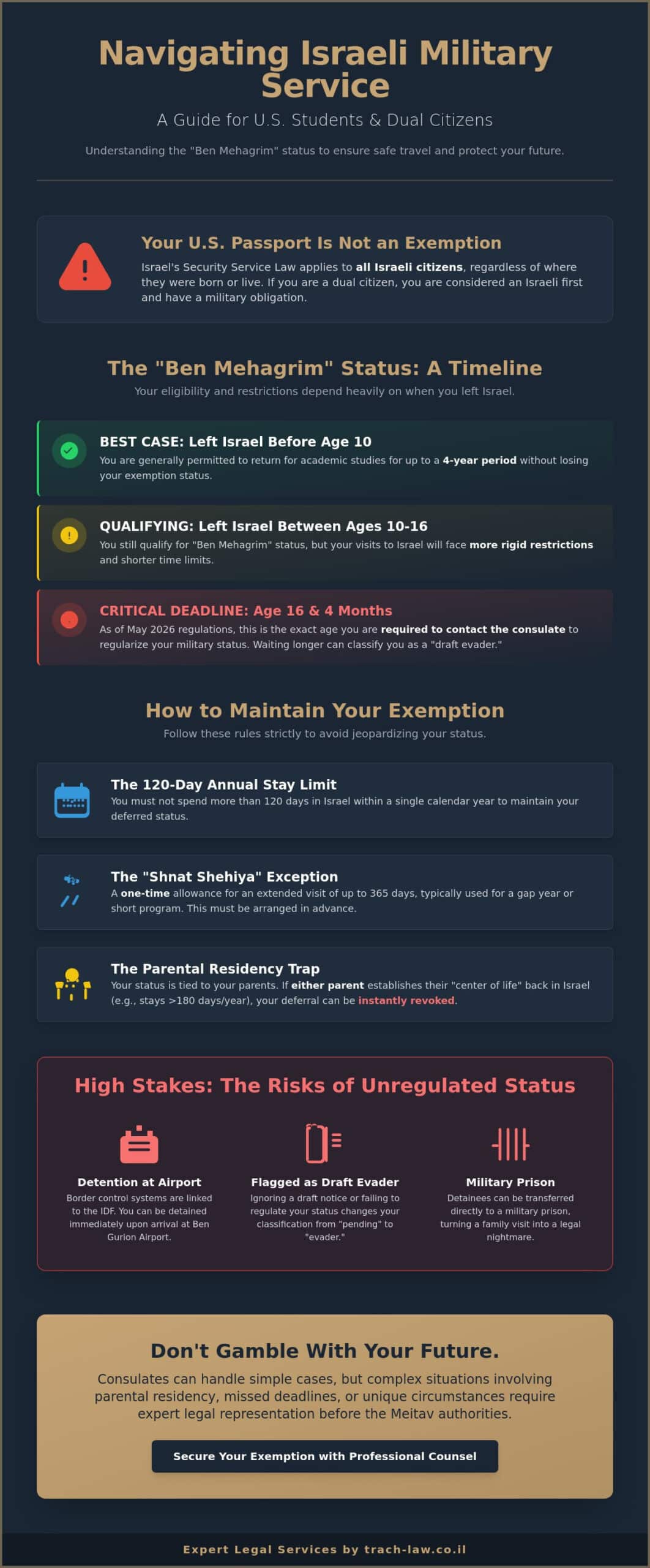
Many American students assume their US passport provides a shield against foreign military service. In reality, the Israeli government views dual citizens first and foremost as Israelis. Under the Israeli Security Service Law, every citizen is legally obligated to serve, regardless of where they were born or where they currently live. This means your American birth certificate doesn't automatically grant you an Israeli army exemption for American students. If you have at least one Israeli parent, the system likely already has you on its radar, even if you've never held an Israeli passport.
The legal timeline is strict and unforgiving. As of May 2026, the "draft age" officially begins when you reach 16 years and 4 months. This is the exact moment you are required to contact the nearest consulate to regularize your status. Many families make the mistake of waiting until the student is 18 or planning a summer trip to Israel. By then, the IDF may have already issued a Tzav Rishon (first draft notice). Ignoring this notice isn't just a missed appointment; it's a legal trigger that moves your file from "pending" to "evader" status, which carries immediate legal consequences the moment you cross the border.
The Security Service Law and Dual Nationality
Israel applies a "Center of Life" test to determine your military obligation. If you left Israel with your parents before age 16, you may qualify for Ben Mehagrim status. However, this isn't a permanent exemption; it's often a conditional deferral that requires constant maintenance. To keep this status, you must ensure your parents stay outside of Israel for more than 180 days per year. If they move back, your deferral could vanish. Understanding these nuances is why seeking a military law expert is vital to protecting your interests and ensuring your stay remains legal.
The Risks of Unregulated Status
Entering Israel with unregulated status is a gamble with high stakes. Ben Gurion Airport's border police systems are directly linked to Meitav, the IDF's processing unit. If you're flagged as a draft evader or deserter, your US passport won't stop an arrest. You could be detained at the airport and transferred to a military prison before you even see your family. This isn't a rare occurrence. Hundreds of dual citizens face these surprises every year because they relied on outdated advice. Securing an Israeli army exemption for American students requires proactive legal steps before you book your flight.
If you are concerned about your military status or need to ensure your visit to Israel is safe and legal, get in touch with Emanuel Tratch Law Office to secure your future.
The "Ben Mehagrim" Status: Your Path to Exemption
The "Ben Mehagrim" status, or "Child of Immigrants," is the primary legal mechanism for securing an Israeli army exemption for American students. It's a proactive classification that recognizes your center of life is firmly established in the United States, which effectively shields you from the standard draft. However, the IDF doesn't just grant this status based on your current address. It hinges heavily on the "Age 10 Rule." If you left Israel before your tenth birthday, the military authorities generally allow you to return for academic studies for up to four years without losing your exemption. If you left between the ages of 10 and 16, you still qualify for the status, but the restrictions on your stay in Israel are much more rigid.
The core of this status is the legal determination that you are an expatriate. As this Ben Mehagrim Status Explained guide details, the classification remains valid only as long as your parents also maintain their life outside of Israel. If your parents move back to Tel Aviv or Jerusalem for more than 180 days in a calendar year, the IDF can revoke your status immediately. This is a frequent trap for families where one parent returns to Israel for work or to care for relatives. You must monitor these residency days with precision to ensure your Israeli army exemption for American students remains legally sound.
Qualifying for Ben Mehagrim Status
To secure this status, you must meet three primary criteria: you must have departed Israel before age 16, your parents must reside abroad, and you must limit your annual visits to Israel to no more than 120 days. Exceeding this 120-day limit by even a single day can trigger the automatic start of your "Shnat Shehiya" (year of stay), which is a one-time privilege. If you are concerned that your travel history or family situation puts your status at risk, it's wise to consult with a legal professional who understands the internal Meitav protocols.
The "Student Year" Exception
For American students who want to experience a gap year or a semester abroad, the "Shnat Shehiya" is a vital tool. This provision allows you to stay in Israel for a period ranging from 121 to 365 days once in your lifetime without being drafted. It's an ideal solution for seminary or university programs. The danger lies in the "second year." If you stay past the 365th day without converting your status to a formal academic deferral, you are no longer a visitor in the eyes of the law; you are a resident subject to immediate conscription.
If you are concerned about your military status or need to ensure your visit to Israel is safe and legal, get in touch with Lawyer Emanuel Tratch (עורך דין עמנואל טראץ) to secure your future.
How to Apply for an IDF Exemption from the United States
Applying for an Israeli army exemption for American students is an administrative marathon that begins long before you pack your bags. The IDF expects you to initiate this process when you turn 16 years and 4 months. Waiting until high school graduation is a gamble you don't want to take. While the Israeli Consulates in New York, Los Angeles, or DC act as the intake point, the final decision rests with the Meitav authorities in Israel. In 2026, the process has moved largely to a digital portal, but the burden of proof remains entirely on your shoulders.
Step 1: Document Collection
You need a bulletproof paper trail. The IDF wants to see that your American life is genuine and that your "center of life" isn't secretly in Israel. They require specific evidence to verify your claim. You should gather the following:
-
Official school transcripts for every academic year since you departed Israel.
-
US tax returns from your parents to prove their financial and physical residency abroad.
-
Utility bills or lease agreements spanning the last three to five years.
-
Entry and exit logs from the Ministry of Interior (Misrad Hapnim) to prove you haven't exceeded stay limits.
Step 2: Submitting the Application
You'll need to complete the "Declaration of Resident Abroad" forms, specifically Form 7202. Accuracy is everything here. A common mistake is providing vague dates or failing to account for every family member's residency. If the IDF sees a gap in your history, they'll reject the application without a second thought. Navigating the Meitav portal can be daunting, but professional military legal representation ensures your documents are filed correctly the first time. If you plan to travel while your file is still open, you must explicitly request an Ishur Hitpayaout.
Step 3: Verifying Your Status
Once Meitav reviews your file, they'll issue a formal response. You must read this carefully to distinguish between a permanent exemption and a temporary deferral. A deferral requires periodic renewal, while an exemption is final. Store these digital permits on your phone and keep a physical copy tucked into your US passport. The Ishur Hitpayaout is the only document that guarantees safe entry into Israel while your application is pending.
If you are concerned about your military status or need to ensure your visit to Israel is safe and legal, get in touch with Emanuel Tratch Law Office to secure your future.
Common Pitfalls and Objections: "But I am an American Student!"
The most dangerous mistake an American student can make is assuming that a US birth certificate overrides Israeli law. If your mother or father held Israeli citizenship at the time of your birth, the state of Israel considers you a citizen by descent. This legal reality exists whether or not you ever held an Israeli passport or stepped foot in the country. Your US passport is a travel document; it is not a legal shield against the sovereign requirements of the Israeli Security Service Law. Relying on your American status alone is a recipe for a high-stress encounter with border police at Ben Gurion Airport.
Another frequent trap is the "One Parent" residency issue. The IDF's Meitav unit typically grants Ben Mehagrim status based on the entire family's "center of life" being abroad. If one parent decides to move back to Israel for work or personal reasons, the student's Israeli army exemption for American students can be voided almost instantly. The military authorities view the return of a parent as a sign that the family is "re-rooting" in Israel, which often triggers an immediate draft notice for the children. You must ensure that both parents remain outside of Israel for more than 180 days per calendar year to keep your status secure.
Confusion also surrounds programs like Masa or various gap years. Many students believe these official programs provide automatic immunity from the draft. In reality, these programs are educational frameworks, not legal ones. While they may facilitate the paperwork, the legal responsibility to secure a deferral or exemption remains with you. Without the correct "Ben Mehagrim" filing, a student on a "Year Course" could be classified as a resident after just a few months, leading to an unexpected conscription order.
The "Accidental" Israeli Citizen
Many families skip registering a birth abroad, thinking it keeps the child "off the grid." This is a misconception that often backfires when the child enters Israel as an adult. The Ministry of Interior's systems are sophisticated and can link travelers to their parents' records during routine checks. This creates what we call a "military debt" that must be settled before you can leave the country. If you are an unregistered citizen, obtaining professional legal representation for military matters is the only way to regularize your status without the risk of immediate detention.
Staying Too Long: The 120-Day Rule
The 120-day annual limit for visitors with Ben Mehagrim status is a hard ceiling. Even a 24-hour overstay due to a flight delay or a family emergency can trigger the "Shnat Shehiya" (year of stay) counter. Once that year is used up, any subsequent visit longer than 120 days will result in the loss of your exemption. You cannot simply explain your way out of this at the airport. To avoid these traps and protect your ability to travel freely, speak with our office today to verify your travel history and status.
If you are concerned about your military status or need to ensure your visit to Israel is safe and legal, get in touch with Lawyer Emanuel Tratch (עורך דין עמנואל טראץ) to secure your future.
Securing Your Future: Why Professional Legal Counsel is Essential
The Israeli Consulate is an administrative body, not a legal advocate. While the staff in New York, Los Angeles, or DC can provide you with the necessary forms, their primary duty is to the state, not to your individual interests. If your application for an Israeli army exemption for American students contains a mistake, or if your family history doesn't perfectly align with the standard criteria, a consulate clerk won't build a defense for you. They will simply reject the file. This is why direct representation before the Meitav authorities in Israel is the only way to ensure your status is resolved with absolute certainty. We act as the bridge between your American life and the rigid Israeli military system.
Beyond the Forms: Strategic Legal Defense
Many students find themselves in a legal gray area because they inadvertently broke the "Age 10" or "Age 16" rules mentioned earlier. Perhaps a family emergency forced an extended stay in Israel, or a parent moved back for a few months without considering the military implications for their children. In these cases, the system often defaults to a harsh classification, sometimes even labeling the student as a "Deserter" (Arik). This status carries the threat of immediate arrest. Resolving these complexities requires more than just paperwork; it requires a deep understanding of the importance of representation by a military lawyer who can negotiate directly with the IDF legal branch. We protect you from the system's rigidity by presenting your case in the language the military authorities respect.
You Are in Good Hands with Emanuel Trach Law Office
Our firm specializes in regulating the status of children of immigrants with a focus on discretion and results. We understand the anxiety that comes with facing a large, inflexible security apparatus. We take the "adult in the room" approach, using our insider knowledge of military protocols to navigate the Meitav portal and consular systems on your behalf. You shouldn't have to guess if your entry to Israel is safe. We provide the legal certainty that your visit or study period will be 100% risk-free. Before you book your flight for the 2026 academic year, ensure your Israeli army exemption for American students is fully verified and legally sound. You can contact us today to secure your military status and travel with total peace of mind.
If you are concerned about your military status or need to ensure your visit to Israel is safe and legal, get in touch with Emanuel Tratch Law Office to secure your future.
Protect Your Freedom and Academic Future in Israel
You shouldn't have to spend your semester in Jerusalem worrying about military police or unexpected airport detentions. Securing an Israeli army exemption for American students isn't about avoiding duty; it's about correctly establishing your legal status before the IDF system makes the decision for you. You've seen how easily a single overstay or a parent's relocation can trigger a conscription order. By acting proactively at age 16 and four months, you ensure that your academic path remains clear and your rights as a dual citizen are fully protected.
Our office brings years of specialized experience within the military justice system to your defense. We handle the complex negotiations with Meitav so you don't have to face a rigid bureaucracy alone. Whether you're appealing a wrongful "deserter" status or simply need an airtight travel permit, we provide the discrete and authoritative representation you deserve. Don't leave your freedom to chance. You can secure your travel to Israel and contact us for a consultation today. We're here to ensure you travel with total confidence.
If you are concerned about your military status or need to ensure your visit to Israel is safe and legal, get in touch with Lawyer Emanuel Tratch (עורך דין עמנואל טראץ) to secure your future.
Frequently Asked Questions
Can I visit Israel as an American student if I haven't received my exemption yet?
No, traveling to Israel without a confirmed status or a "Travel Permit" (Ishur Hitpayaout) is extremely risky. The IDF system automatically flags draft-eligible citizens who haven't regularized their status. Border police at Ben Gurion Airport have the authority to detain you immediately and transfer you to a military induction center. You should secure your Ben Mehagrim status or at least a temporary permit before boarding your flight to ensure your entry is legal.
Does getting a Ben Mehagrim exemption mean I lose my Israeli citizenship?
No, obtaining this status doesn't affect your citizenship or your rights as an Israeli national. Ben Mehagrim is a military classification that recognizes your "center of life" is in the United States, not a renunciation of your nationality. You'll still hold your Israeli passport and retain the ability to vote or own property. It simply regularizes your military obligation so you can visit family or study without the fear of being drafted.
What happens if I stay in Israel for more than one year of study?
You risk losing your exemption and being classified as a full resident subject to conscription. The "Shnat Shehiya" provision allows for a one-time stay of up to 365 days. If you exceed this limit without a formal academic deferral, which is typically reserved for those who left Israel before age 10, the IDF will cancel your Israeli army exemption for American students. This change in status is often permanent and very difficult to reverse.
My parents moved back to Israel; does this affect my military exemption?
Yes, your parents' residency is a critical factor in maintaining your status. The IDF requires that both parents reside outside of Israel for at least 180 days within a calendar year. If one parent moves back to Israel permanently, the military authorities consider your family's center of life to have shifted. This often triggers an immediate cancellation of your Ben Mehagrim status, even if you personally remain in the United States for school.
I already received a draft notice in the mail to my US address; what should I do?
You must act immediately and avoid traveling to Israel until the notice is resolved. A draft notice (Tzav Rishon) indicates that the IDF has already opened a formal file and expects your appearance at an induction center. Ignoring this leads to a "Draft Evader" classification in the national database. You should contact a specialized lawyer to negotiate with the Meitav authorities and regularize your status from abroad before any legal deadlines pass.
Can a lawyer help me get an exemption if the Consulate already said no?
Yes, a lawyer can often secure a positive result by appealing directly to the Meitav authorities in Israel. Consulates function as administrative offices and don't have the legal discretion to deviate from standard protocols. A legal expert with military justice experience can present a strategic defense based on technicalities in the Security Service Law or specific hardships that a consulate clerk isn't authorized to consider. Direct representation is frequently the only way to resolve complex or rejected cases.
Is there a medical exemption (Profile 21) available for American students?
Yes, students with documented physical or mental health conditions can apply for a Profile 21 medical exemption. This process requires you to submit comprehensive medical records to a military medical board for review. While Ben Mehagrim status is based on where you live, a medical exemption is based on your fitness for service. A lawyer can help ensure your US medical documents meet the strict evidentiary standards required by IDF medical committees to secure a permanent release.
How much does it cost to hire a lawyer for an IDF exemption case?
Legal fees depend on the complexity of your specific case and the level of direct negotiation required with the military authorities. While we don't provide fixed prices without a case review, the cost covers the entire process from document verification to securing your final travel permit. Investing in professional counsel is a preventative measure that protects you from the far higher costs of military imprisonment, legal fines, or a lost academic year.
If you are concerned about your military status or need to ensure your visit to Israel is safe and legal, get in touch with Lawyer Emanuel Tratch (עורך דין עמנואל טראץ) to secure your future.

Article by
עמנואל טראץ', עו"ד ונוטריון
עו"ד ונוטריון עמנואל טראץ', עורך דין בעל ניסיון עשיר, חבר בלשכת עורכי הדין החל משנת 2011.
עורך דין פרטי ותיק, בעברו שימש כיועץ משפטי בחטיבה להתאמה ביטחונית בשב"כ (סיווג ביטחוני) ויועץ משפטי בתחום הפלילי והמנהלי. פועל בשוק הפרטי משנת 2013, ומייצג לקוחות פרטיים ותאגידים. בשירותו הצבאי, שירות כחוקר בכיר וראש צוות חוקרים במצ"ח ביחידה המרכזית לחקירות מיוחדות (ימל"מ).
הבהרה
המידע באתר הוא מידע כללי ואינו מידע מחייב. הזכויות המחייבות נקבעות על-פי חוק, תקנות ופסיקות בתי המשפט. השימוש במידע המופיע באתר אינו תחליף לקבלת ייעוץ או טיפול משפטי, מקצועי או אחר והסתמכות על האמור בו היא באחריות המשתמש בלבד
פנה לקבלת
ייעוץ משפטי ללא התחייבות