
Purchase Agreements in Israel: The Essential Guide by an Israeli Lawyer (2026)
Signing a "simple" memorandum of understanding in Israel isn't just a handshake; it's often a legally binding trap that can trigger massive tax liabilities before you even see a formal contract. You likely feel that the Israeli property market is a maze of bureaucracy, especially with the February 2026 Land Registration Reform and the new 1.5% vacant property tax looming over your investment. It's natural to worry about hidden liens or the complexity of the Tabu registration process. You want to know your investment is safe and your family's future is protected.
This guide provides the expert clarity you need to move forward with total confidence. By working with a specialized purchase agreements israeli lawyer, you can navigate the new 2026 registration rules and secure a protective contract that shields your capital. We'll break down the 2026 tax brackets, explain the 18% VAT implications, and show you exactly how to ensure a smooth registration in the Land Registry. You're in good hands. We'll ensure every legal detail is handled with the precision and discretion your transaction deserves.
Key Takeaways
- Understand why oral "handshake" deals are legally void in Israel and how the formal Hoseh Mecher establishes a binding framework for your property transaction.
- Discover how a dedicated purchase agreements israeli lawyer performs essential due diligence in the Land Registry (Tabu) to identify hidden liens or zoning irregularities.
- Learn to navigate the "As-Is" clause and payment schedule linkages to shield yourself from undisclosed property defects and the volatility of the Building Input Index.
- Master the 2026 regulatory landscape to ensure your registration is seamless while avoiding costly conflicts of interest by maintaining independent legal representation.
Understanding Purchase Agreements in the Israeli Legal System
The Israeli Purchase Agreement, known locally as the Hoseh Mecher, is a legally binding bilateral commitment that serves as the foundation of any property transaction. It's more than just a list of prices and dates; it's a comprehensive legal shield designed to define the transfer of rights from one party to another under the strict supervision of Israeli land and property laws. When you enter this process, you aren't just buying a home; you're navigating a complex regulatory environment governed primarily by the Contracts Law (1973) and the Land Law (1969).
In many cultures, a handshake or an oral promise carries weight. In the Israeli real estate market, these gestures have zero legal standing. Section 8 of the Land Law (1969) explicitly mandates that any real estate transaction must be concluded in writing to be enforceable. Without a formal document drafted by a qualified purchase agreements israeli lawyer, your "deal" doesn't exist in the eyes of the court. This requirement exists to protect you from impulsive decisions and to ensure that every detail of the property's status is fully documented before capital changes hands.
A Zichron Devarim is a potentially binding trap for the unwary that can create irreversible legal facts before you've even performed basic due diligence.
The Trap of the Zichron Devarim (MOU)
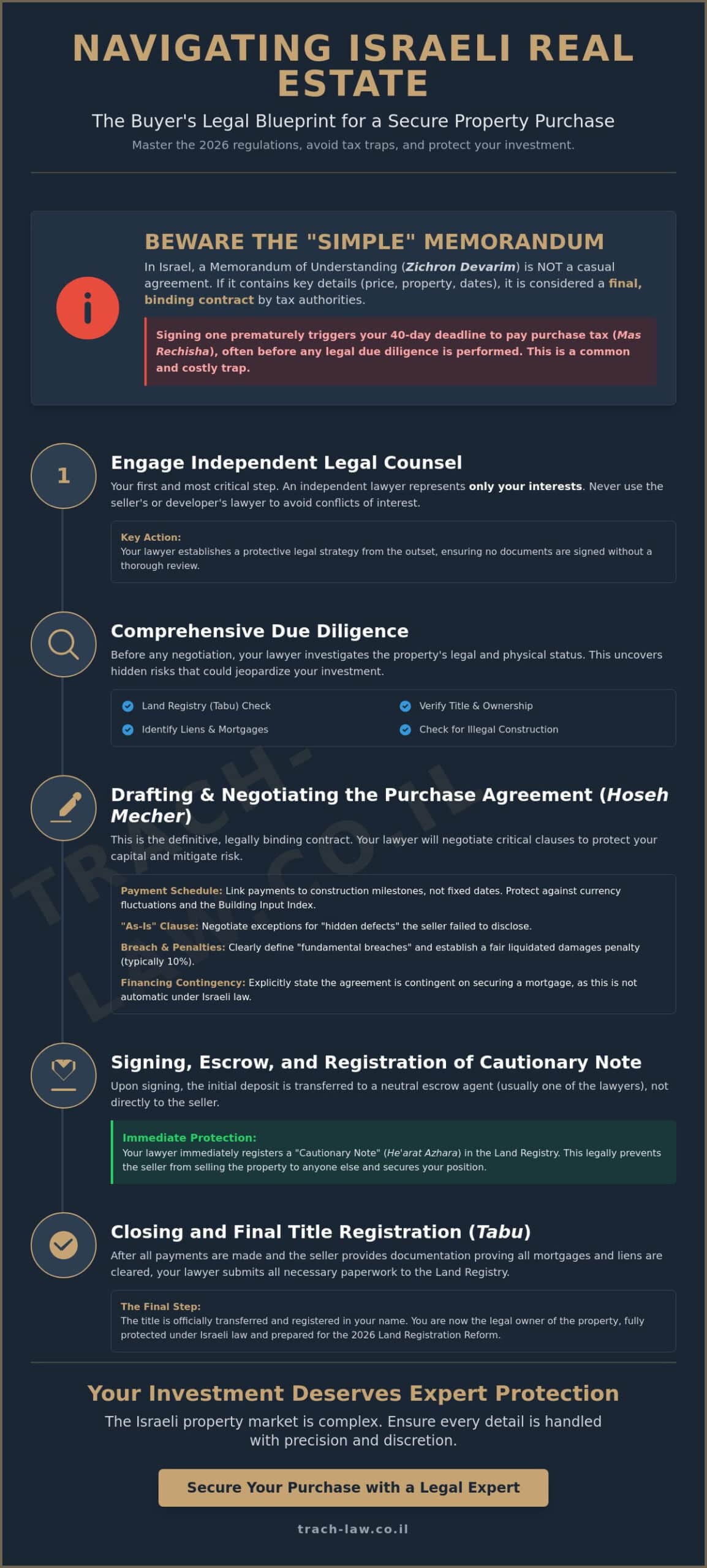
Many buyers are pressured by agents or sellers to sign a "simple" memorandum of understanding to "lock in" the price. This is often a legal disaster. In Israel, if a Zichron Devarim contains the essential elements of a deal—price, property identification, and dates—the courts and tax authorities treat it as a final, binding contract. This means your 40-day window to pay purchase tax (Mas Rechisha) starts the moment you sign that "simple" paper. If you later discover the property has a hidden lien or illegal construction, you're already legally committed. We strongly advise that you never sign anything without our prior review to ensure your interests are fully protected from the start.
Key Parties and Their Legal Roles
Every successful transaction requires a clear division of responsibilities. The Seller is legally obligated to provide full disclosure regarding the property's physical and legal condition, ensure the title is clear, and remove any existing encumbrances or mortgages before the final transfer. As the Buyer, your primary obligations involve adhering to a strict payment schedule and reporting the transaction to the tax authorities within the legal timeframe. To bridge the gap of trust, we utilize an escrow agent—typically one of the representing lawyers—to hold the initial deposit. This ensures your funds aren't released to the seller until a cautionary note (He'arat Azhara) is registered in your name, providing you with immediate protection in the Land Registry. For expert guidance on these roles, you can explore our real estate legal services to see how we manage these complexities for our clients.
Critical Clauses and Negotiations: Protecting Your Interests in 2026
Negotiating a property deal in Israel requires more than just agreeing on a price. It's a strategic battle over risk allocation. Sellers often push for an "As-Is" clause, which attempts to absolve them of liability for any physical defects. You shouldn't accept this blindly. We negotiate specific exceptions to ensure the seller remains liable for "hidden defects"—issues they were aware of but didn't disclose. When negotiating purchase agreements israeli lawyer expertise becomes your most valuable asset in identifying these subtle traps that could cost you hundreds of thousands of shekels in future repairs.
In 2026, payment schedules are more complex due to market volatility. If you're buying a new property from a developer, your remaining balance is typically linked to the Building Input Index. For resale properties, we often negotiate linkages to currency exchange rates to protect your purchasing power. We also define "fundamental breaches" clearly. In Israel, a fundamental breach—such as a payment delay of more than a few days—usually triggers a liquidated damages penalty of 10% of the total purchase price. We ensure these penalties are balanced and that "Conditions Precedent" are included. Since Israeli law doesn't provide automatic contingencies for financing, we must explicitly state that the deal is contingent on you securing a mortgage at the March 2026 market rates.
Representations and Warranties
We demand rigorous warranties from the seller regarding their legal capacity. This includes verifying they aren't in bankruptcy and that the property isn't subject to "protected tenancies," an old legal status that can make it impossible to evict a tenant. Maintaining a "Clear Title" warranty in 2026 is the primary defensive line against the evolving regulatory changes introduced by the Israel Land Authority regarding land management and historical claims. We verify that no third-party rights or undisclosed debts exist before you commit your first shekel.
The Trust (Escrow) Mechanism
Your money shouldn't go directly to the seller's pocket on day one. We use a sophisticated trust mechanism where the initial payment is held in escrow. This money is only released once a Caution Note (He'arat Azhara) is registered in your name at the Land Registry. This protects your funds from the seller's potential creditors or any attempts to sell the property to someone else simultaneously. Furthermore, 2026 bank requirements for anti-money laundering (AML) compliance are stricter than ever. We guide you through the "source of funds" documentation to ensure your bank doesn't freeze the transaction mid-process. If you're unsure about the specific risks in your contract, seeking professional real estate representation is the best way to secure your capital. You're in good hands when we manage these regulatory hurdles for you, ensuring a discreet and efficient closing.
Essential Due Diligence and Regulatory Compliance
Due diligence in the Israeli market isn't a formality; it's a forensic investigation. With the Israel Land Registration Reform of February 2026, property titles in specific regions are undergoing significant shifts in registration status. We don't just look at the price; we interrogate the property's history. A professional purchase agreements israeli lawyer must verify whether the property is registered in the "Tabu" (Land Registry) or via an "Ishur Zichuy" (Rights Authorization) through a housing company or the Israel Land Authority. We also cross-reference the physical structure with official municipal permits. If that sunroom or balcony doesn't match the zoning blueprint, you're inheriting a legal liability that could lead to demolition orders or heavy fines from the local council.
Most land in Israel is state-owned and managed by the Israel Land Authority (Rami). You need to understand if you're buying "freehold" land or a "leasehold" that requires periodic renewal fees or capitalization payments. Our background in security regulations gives us a unique edge here. We identify if the land sits in "security-sensitive" zones or near military installations. These areas often require specific approvals that general civil lawyers might overlook. If the property is in a restricted zone, the purchase process follows a completely different regulatory path that requires a "militarized" level of precision to navigate successfully.
Financial Due Diligence: Taxes and Levies
Tax liabilities can destroy your expected ROI if they aren't calculated accurately before you sign. As of February 2026, foreign investors pay an 8% purchase tax (Mas Rechisha) on the first 6,055,070 shekels of the property's value. If the price exceeds that threshold, the rate jumps to 10%. In contrast, Israeli residents buying their only home benefit from a 0% rate on the first 1,978,745 shekels. We also look for the "Heitel Hashbacha" (Betterment Levy). This is a municipal tax on the increase in property value due to approved building rights. We ensure the contract mandates the seller pays this before closing; otherwise, the municipality will block the transfer of rights to your name. We also handle the mandatory withholding for Capital Gains Tax (Mas Shevach) to ensure the tax authorities are satisfied and your registration remains on track.
Special Considerations for Foreign Buyers
Buying from abroad adds layers of complexity that require a protective legal hand. Non-citizens face strict restrictions on purchasing agricultural land or plots designated as "security-sensitive" under the latest 2026 guidelines. You don't need to be physically present to sign the contract, but your Power of Attorney (POA) must be drafted with surgical precision. We handle the apostille process and consular verifications to ensure your signature carries full legal weight in Israel. You can explore our specialized Real Estate Services to see how we protect international capital from local bureaucratic traps. We act as your eyes and ears on the ground, ensuring that sensitive data and your financial interests are guarded with the highest level of discretion.
The Step-by-Step Purchase Process: From Negotiation to Closing
The journey from finding a property to holding the keys is a structured legal operation. It begins with the exchange of contract drafts. This isn't a simple swap of documents; it's a phase where your purchase agreements israeli lawyer deconstructs the seller's terms to build a "protective version" that prioritizes your capital. Once we've negotiated the specific warranties and payment linkages discussed earlier, both parties sign the formal agreement. This signature triggers a sequence of non-negotiable legal deadlines that require immediate action to maintain the contract's validity.
Immediately after signing, we register a Caution Note (He'arat Azhara) in the Land Registry. This is your primary defense against "double-selling" scams. It signals to the world that you have a prior claim to the property. The process then moves toward the final payment and handover. At the closing meeting, the seller receives the final balance in exchange for the keys and a set of critical documents. These documents allow us to complete the transfer of title. If any certificate is missing, we withhold a portion of the funds in escrow to ensure the seller remains motivated to clear all municipal debts.
Reporting to the Tax Authority
You have a narrow window of 30 to 40 days to report the transaction to the Israeli Tax Authority. In 2026, the digital filing systems are more rigid, and missing a deadline results in automatic penalties. We handle these filings to ensure you claim every available exemption. If you're a first-time buyer or a new immigrant (Oleh Hadash), you may be eligible for significant reductions in purchase tax. We secure the necessary "tax clearance" certificates, which are essential for the final registration. Without these, the Land Registry won't recognize you as the owner. For a secure transition through these bureaucratic hurdles, you can book a legal consultation with our team to protect your investment.
Final Registration and Title Transfer
The process doesn't end when you move in. We must gather the "Five Certificates," including tax clearances and municipal approvals, to finalize the permanent registration in the Tabu. This final step can take several months depending on the municipality's efficiency and the 2026 Arnona adjustments. The legal finality of the 'Tabu' registration is what truly converts your contractual right into a permanent property right. Until this is complete, the transaction remains technically "open" in the eyes of the state. We manage this entire tail-end of the process with the same discretion and precision we applied to the initial negotiation.
Why Professional Legal Representation is Non-Negotiable
In the Israeli property market, the temptation to cut costs by sharing a lawyer with the seller is a dangerous trap. While it might seem efficient, it creates a fundamental conflict of interest that leaves you vulnerable if the deal sours. You need an advocate whose sole mission is to protect your capital and your future. When you hire a specialized purchase agreements israeli lawyer, you aren't just paying for a signature; you're investing in a protective shield that ensures the seller's interests never take priority over yours. We've seen far too many cases where buyers lost their deposits or inherited illegal construction because they didn't have independent representation to fight for the necessary warranties.
The Trach Law advantage lies in our unique ability to bridge the gap between standard civil transactions and the rigid security landscape of 2026. With the recent Israel Land Registration Reform in February 2026 affecting property titles in the West Bank and other sensitive regions, the stakes have never been higher. We understand the system from the inside. Whether your transaction involves complex inheritance issues or land adjacent to military installations, we provide a level of precision that general practitioners simply can't match. You can move forward with total peace of mind, knowing you are in good hands with a team that treats your investment with the discretion and seriousness it deserves.
A Protective Shield for Your Investment
Our firm identifies red flags that generic lawyers often miss, such as subtle discrepancies in municipal permits or historical claims that could resurface under the 2026 registration rules. We don't just read the contract; we interrogate every clause to ensure it aligns with your long-term goals. Having a lawyer who knows how to navigate the bureaucracy of the Israel Land Authority and the tax offices is the difference between a seamless transaction and a multi-year legal battle. If you're ready to secure your property with an expert advocate, you should contact us for a legal consultation today.
Comprehensive Legal Support Beyond the Contract
A property purchase is often just one piece of a larger financial puzzle. We provide comprehensive support that integrates your purchase agreement with essential inheritance planning and the drafting of wills to protect your heirs. For our international clients, we offer specialized notary services to facilitate remote signings and consular verifications without the need for constant travel. Our goal is to provide a holistic legal experience where every detail is handled with surgical precision. You can learn more about Trach Law Office and our commitment to uncompromising professional authority. We're here to ensure that your entry into the Israeli real estate market is secure, efficient, and entirely discreet.
Secure Your Future in the Israeli Property Market
Navigating the Israeli real estate landscape in 2026 requires more than just financial capital; it demands a defensive legal strategy. You've learned how the February 2026 Land Registration Reform and complex tax brackets can impact your bottom line. You also understand why avoiding a Zichron Devarim and securing a protective contract are vital steps. Relying on an experienced purchase agreements israeli lawyer ensures that your rights are registered correctly in the Tabu and that no hidden liens threaten your asset.
Our office specializes in the intersection of civil property law and sensitive security regulations. We provide the discrete, personalized attention you need to navigate these large, often rigid systems. With a proven track record in high-stakes transactions, we ensure your interests are guarded at every turn. Secure your Israeli investment today. Contact the Emanuel Trach Law Office for a protective legal consultation. You're making a significant move for your family's future, and we're here to make sure you move forward with total confidence.
Frequently Asked Questions
Can I sign an Israeli purchase agreement remotely from abroad?
Yes, you can conclude the entire transaction without being physically present in Israel. This is accomplished by signing a specific Power of Attorney (POA) at an Israeli consulate or before a notary with an apostille certification. Your purchase agreements israeli lawyer then uses this document to sign the contract and tax declarations on your behalf. We handle the coordination with international consulates to ensure your remote signing meets all 2026 regulatory standards for authenticity and security.
What is the typical lawyer fee for a real estate purchase agreement in Israel?
Legal fees for property transactions generally range from 0.5% to 1.5% of the total purchase price. It's important to remember that an additional 18% VAT is applied to these professional fees as of early 2026. This fee covers the entire scope of work, including title searches, contract negotiations, escrow management, and the final registration of rights in the Land Registry (Tabu). We provide a clear fee structure upfront to ensure your budget remains predictable.
How much is the Purchase Tax (Mas Rechisha) in 2026 for foreign residents?
Foreign residents and investors pay a set rate of 8% on the first 6,055,070 shekels of the property's value. According to the updated brackets for February 1, 2026, any portion of the price exceeding this threshold is taxed at 10%. Unlike Israeli residents buying their only home, foreign buyers don't receive a 0% tax bracket on the initial portion of the purchase. We calculate these exact liabilities during the initial negotiation phase to avoid any financial surprises.
What happens if I signed a Zichron Devarim without a lawyer?
Signing a Zichron Devarim often creates a binding legal reality that triggers your 40-day window for tax reporting. If the document contains the price, property details, and dates, the Israeli Tax Authority views it as a completed deal, regardless of whether a formal contract exists. You should contact us immediately if you've signed such a document. We'll work to mitigate potential penalties and ensure the subsequent formal agreement protects you from any hidden defects discovered after that initial signature.
Does an Israeli purchase agreement need to be in Hebrew or English?
The binding version of the contract must be in Hebrew for it to be accepted by the Land Registry and Tax Authorities. While we provide comprehensive English translations for our international clients, the Hebrew text is the only version with legal standing in an Israeli court. We go through the Hebrew document line by line with you to ensure you're comfortable with every term and warranty before any commitment is made. Your understanding is our priority.
How long does the entire process take from signing to Tabu registration?
The transition from signing the contract to final registration in the Tabu usually spans 4 to 9 months. While you'll typically receive the keys and possession within 2 to 5 months, the final title transfer requires several clearance certificates from the municipality and tax offices. We manage the collection of the "Five Certificates" to ensure the process doesn't stall. Our team monitors the timeline closely to protect you from bureaucratic delays that could affect your property rights.
What is a 'Caution Note' (He'arat Azhara) and why is it vital?
A Caution Note is a public entry in the Land Registry that signals your legal claim to the property. It's vital because it prevents the seller from performing any conflicting transactions, such as selling the property to another party or taking out a new mortgage. We register this note immediately after the first payment is released from escrow. This serves as your primary defensive shield, ensuring that your investment is secured against the seller's creditors or potential fraud.
Are there additional costs besides the purchase price and taxes?
Yes, you should budget between 10% and 16% of the purchase price for total closing costs. Beyond the purchase tax, this includes agent fees (typically 2% plus 18% VAT), lawyer fees, and mortgage bank valuation costs. You must also account for the 1.626% nationwide increase in municipal property tax (Arnona) confirmed for 2026. We provide a detailed breakdown of these costs early in the process so you can manage your capital with total transparency and confidence.

Article by
עמנואל טראץ', עו"ד ונוטריון
עו"ד ונוטריון עמנואל טראץ', עורך דין בעל ניסיון עשיר, חבר בלשכת עורכי הדין החל משנת 2011.
עורך דין פרטי ותיק, בעברו שימש כיועץ משפטי בחטיבה להתאמה ביטחונית בשב"כ (סיווג ביטחוני) ויועץ משפטי בתחום הפלילי והמנהלי. פועל בשוק הפרטי משנת 2013, ומייצג לקוחות פרטיים ותאגידים. בשירותו הצבאי, שירות כחוקר בכיר וראש צוות חוקרים במצ"ח ביחידה המרכזית לחקירות מיוחדות (ימל"מ).
הבהרה
המידע באתר הוא מידע כללי ואינו מידע מחייב. הזכויות המחייבות נקבעות על-פי חוק, תקנות ופסיקות בתי המשפט. השימוש במידע המופיע באתר אינו תחליף לקבלת ייעוץ או טיפול משפטי, מקצועי או אחר והסתמכות על האמור בו היא באחריות המשתמש בלבד
פנה לקבלת
ייעוץ משפטי ללא התחייבות