
Mastering Purchase Agreements: A Comprehensive Legal Guide for 2026
The strength of your contract isn't found in the terms you agree to, but in the contingencies you hope you never have to use. You likely feel that the modern market is a minefield of hidden liabilities and dense legal jargon that seems designed to confuse. It's natural to worry about regulatory compliance, especially with new 2026 mandates like the FinCEN reporting for all-cash purchases or evolving disclosure mandates regarding electrical systems and AI-altered images. You've worked hard for your capital, and you deserve to know that your earnest money is safe and your assets are protected.
You're in good hands here. I'll show you how to draft, negotiate, and execute ironclad purchase agreements that minimize your legal liability and provide clear exit strategies. We'll examine the specific clauses that protect your interests in a 2026 landscape where average 30-year fixed mortgage rates fluctuate between 6.3% and 6.5%. This guide provides a direct path to a legally binding document that holds up in court. We'll move from the essentials of the 7 to 14-day residential due diligence period to the advanced tactics of regulatory compliance for specialized assets.
Protecting your future requires a legal partner who understands the system from the inside. Contact עמנואל טראץ', עורך דין ונוטריון today for a professional consultation to ensure your interests are guarded by an expert who knows how to navigate complex regulatory environments. Reach out to our office to schedule your session and gain the peace of mind that comes from knowing your legal affairs are handled with absolute precision and discretion.
Key Takeaways
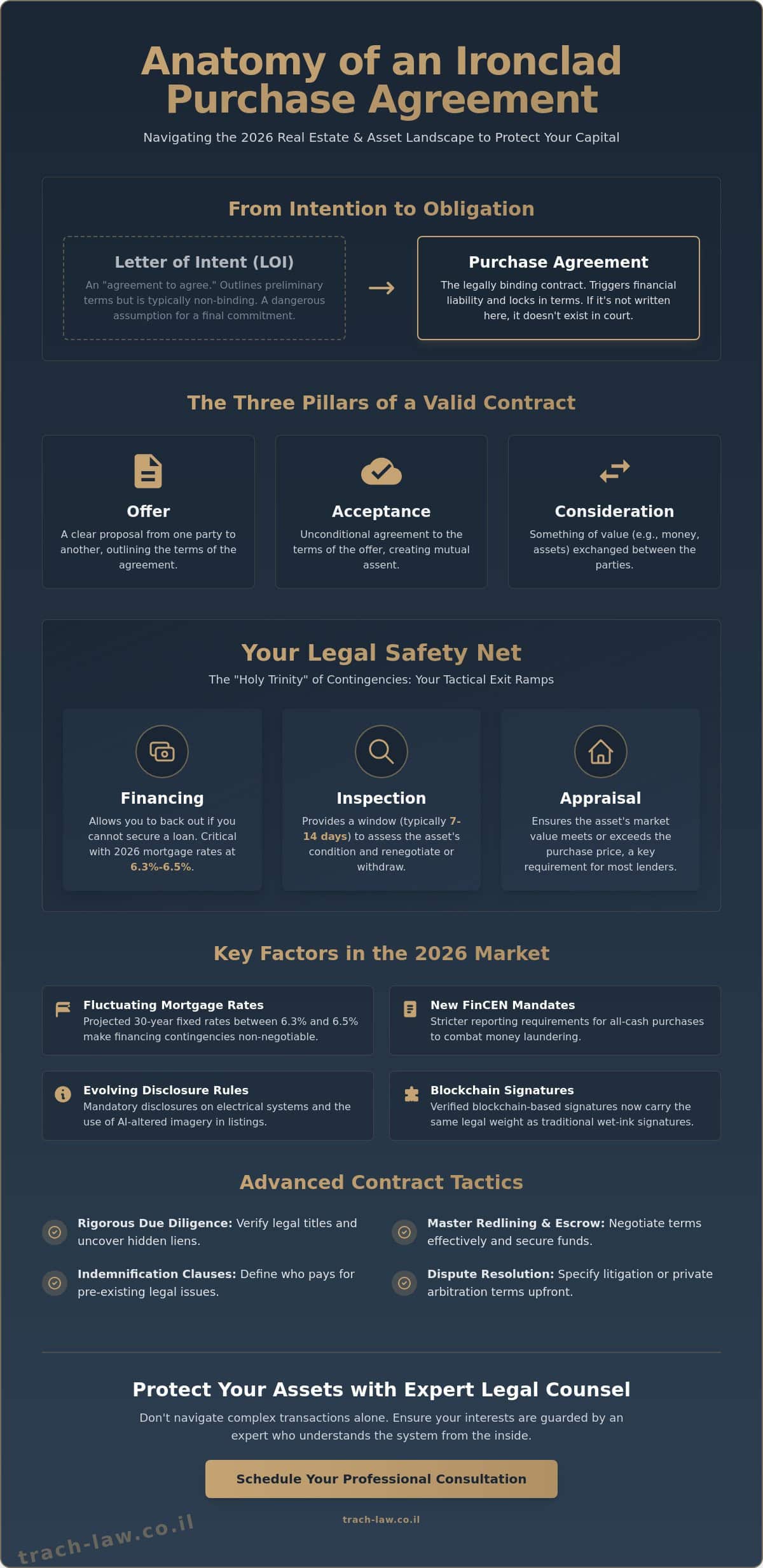
- Distinguish between a non-binding Letter of Intent and a final contract to ensure you don't trigger legal obligations before you're ready.
- Implement the "Holy Trinity" of contingencies-financing, inspection, and appraisal-within your purchase agreements to create an essential safety net for your capital.
- Mitigate risk by applying rigorous due diligence to verify legal titles and uncover hidden liens that could threaten your ownership rights.
- Master the redlining and escrow phases to negotiate terms effectively and manage the secure transition of funds and title.
- Navigate complex transactions for specialized assets that require Ministry of Defense oversight or high-level security clearance with expert precision.
Understanding Purchase Agreements: More Than Just a Price Tag
Think of your contract as a tactical map. It doesn't just show the destination; it identifies every potential ambush point along the way. In high-value transactions, the document officially known as a Purchase and Sale Agreement (PSA) serves as the foundational architecture for the entire transfer. It's the moment where abstract negotiations transform into concrete, enforceable obligations. Without a meticulously drafted document, you aren't just buying an asset; you're buying a potential lawsuit. You need to understand that purchase agreements are designed to lock in the variables that matter most: price, condition, and the exact timeline for delivery.
Many clients mistake a Letter of Intent (LOI) for a final commitment. This is a dangerous assumption. An LOI is often a non-binding "agreement to agree," whereas the final contract is the trigger for legal and financial liability. If a dispute reaches a courtroom, judges rely on the Parol Evidence Rule. This rule generally prevents parties from introducing evidence of prior verbal promises that contradict the written text. If it's not in the signed document, it effectively doesn't exist. This makes the written word your only true shield against "he said, she said" scenarios in complex transactions.
The Legal Binding Nature of Contemporary Contracts
A valid contract rests on three pillars: Offer, Acceptance, and Consideration. In the 2026 regulatory environment, digital signature laws have evolved to provide even greater security. Verified blockchain-based signatures now carry the same weight as traditional wet-ink signatures, provided they meet specific encryption standards. A contract becomes legally enforceable the moment all parties express mutual assent through a signed instrument that exchanges specific value for defined obligations. It's at this precise second that your earnest money deposit is officially at risk if you fail to perform.
Purchase Agreements vs. Purchase Orders
Don't confuse a simple Purchase Order (PO) with a comprehensive agreement. A PO is typically used for one-off commodity purchases, like office supplies or standard equipment. However, when you're transferring complex assets, real estate, or sensitive technology, you need the protection of a full agreement. These documents include "Merger Clauses," which state that the written contract represents the entire agreement between the parties. This prevents a seller from later claiming there were additional side deals or verbal warranties not included in the text. You're in good hands when every detail is codified within the four corners of the document.
Protecting your assets in 2026 requires more than just a standard template; it requires the scrutiny of a legal professional who understands the complexities of both civil and security-related transactions. Contact Attorney Emanuel Trach today for a professional legal consultation to ensure your interests are fully guarded. You can reach our office at 055-2550011 or visit us at our office to discuss your specific needs and secure your future with an ironclad legal defense.
Essential Clauses and Contingencies: Your Legal Safety Net
A contract is only as strong as its exit ramps. In the legal world, these ramps are known as contingencies. They represent the specific conditions that must be met for the transaction to proceed to closing. Without them, you're locked into a deal even if the property is crumbling or the bank refuses your loan. High-stakes purchase agreements typically rely on what I call the "Holy Trinity" of contingencies: financing, inspection, and appraisal. Each one serves as a tactical defense, ensuring you aren't forced to sacrifice your capital for a compromised asset.
Beyond these basics, you must address the complex layers of liability. This involves drafting detailed Essential Clauses and Contingencies that cover indemnification and dispute resolution. Indemnification clauses are particularly vital; they dictate who bears the financial burden if a third party sues over an issue that existed before the sale. Whether you choose litigation in the civil courts or private arbitration, your agreement must specify the venue and the rules of engagement. Choosing the right path can save you years of legal slogging and hundreds of thousands of shekels in fees.
Financial Contingencies and Earnest Money
Your earnest money deposit is more than a gesture of commitment; it's a hostage situation if your contract isn't drafted correctly. In May 2026, with 30-year fixed mortgage rates hovering between 6.3% and 6.5%, the ability to secure financing is never a guarantee. You must define "Good Faith" efforts clearly. This prevents a seller from claiming you didn't try hard enough to get a loan just to keep your deposit. If you're dealing with all-cash purchases, remember that the FinCEN reporting rule effective March 1, 2026, requires strict transparency regarding beneficial ownership. Failure to comply can stall your funds and trigger federal scrutiny.
Representations, Warranties, and Covenants
There's a massive legal gulf between what a seller says and what they guarantee. Representations are statements of past or present facts, while warranties are promises that those facts will remain true. For example, a seller might represent that there are no undisclosed liens. If this turns out to be false, the warranty provides your basis for a claim. You also need to negotiate "survival periods." These define how long the seller's promises remain actionable after the keys change hands. Covenants, on the other hand, are the "to-do" list. They might require the seller to maintain the property's condition or keep insurance active until the very moment of closing.
Drafting these protections requires a sharp eye for detail and a deep understanding of the risks inherent in the Israeli market. To ensure your contract is truly ironclad, it's wise to consult with a professional who can identify the specific vulnerabilities in your deal before you sign on the dotted line.
Securing your assets starts with the right legal strategy. Contact Attorney Emanuel Trach today for a professional legal consultation to ensure your interests are guarded by an expert who knows how to navigate complex regulatory environments. Reach out to our office at 055-2550011 or visit us to schedule your session and gain the peace of mind that comes from knowing you're in good hands.
The Role of Due Diligence: Mitigating Risk Before Execution
The law rarely favors the naive. While we've discussed the structural integrity of purchase agreements, the document's effectiveness depends entirely on the accuracy of the data it contains. In high-stakes legal transactions, the principle of "Caveat Emptor" (Buyer Beware) remains the dominant rule. You cannot afford to rely on a seller's verbal assurances or even their written representations without independent verification. In the Israeli market, where property ownership is often layered with historical claims and complex family ties, being proactive isn't just a choice; it's your primary tactical defense.
One of the most common pitfalls involves assets tied to estates. If the property or business you're acquiring is part of an inheritance, you must verify that a valid Inheritance Order (Tzav Yerusha) has been issued and properly registered. Without this document, the person signing the contract may lack the legal authority to transfer the title, which could render your entire agreement void and tie up your capital in probate court for years. For specialized assets, such as those requiring security clearances or Ministry of Defense oversight, due diligence must also include an audit of regulatory compliance with agencies like the Defense Export Control Agency (AFI).
Verifying Asset Integrity and Legal Standing
A comprehensive title search is non-negotiable. You're looking for "Clouded Titles"-undisclosed liens, secondary mortgages, or long-standing easements that could restrict your use of the asset. Clearing these clouds before signing ensures that you receive a clean, marketable title at closing. You must also distinguish between the physical condition of an asset and its legal standing. A building might be structurally sound but legally "broken" if it lacks the proper permits or violates updated 2026 zoning ordinances. We apply security-level scrutiny to these checks to ensure you're stepping into a secure investment.
Hidden Liabilities and Post-Closing Protection
Your investigation must extend beyond the physical asset to the seller's legal history. This includes checking for pending litigation, outstanding regulatory fines, or undisclosed environmental liabilities. Since the March 1, 2026 FinCEN rule now mandates strict reporting for all-cash purchases, any lack of transparency regarding the seller's beneficial ownership could trigger federal audits that freeze the transaction. Exhaustive due diligence serves as your primary leverage, providing the factual evidence needed to negotiate the final purchase price downward if defects or liabilities are discovered.
Don't leave your assets to chance. Contact Attorney Emanuel Trach today for a professional legal consultation to ensure your due diligence is handled with the precision and discretion you deserve. Reach out to our office at 055-2550011 or visit us to discuss your specific case and ensure you're in good hands before you commit your capital.
The Transaction Lifecycle: From Negotiation to Closing
The lifecycle of purchase agreements isn't a linear path; it's a series of tactical engagements where every move determines your final level of protection. Once the initial draft is on the table, the redlining process begins. This is where we strip away unfavorable terms and insert the specific protections discussed in previous sections. You aren't just negotiating a price. You're negotiating the allocation of risk. Successful redlining requires a balance between firm legal boundaries and the momentum needed to keep the deal alive. If you push too hard on minor points, the seller might walk. If you're too lenient, you leave your assets exposed.
Negotiation Strategies for High-Stakes Agreements
In the 2026 market, "Closing Credits" have become a primary tool for resolving issues found during the due diligence period. If an inspection reveals a defect, rather than delaying the closing for repairs, we often negotiate a financial credit. This keeps your timeline intact while ensuring the seller pays for the remedy. You must also insist on "Time is of the Essence" clauses. These clauses turn target dates into hard legal deadlines. Without them, a seller might drag their feet, leaving your capital in limbo while mortgage rates potentially climb toward the 6.75% mark predicted by some analysts for late 2026.
The escrow period serves as the neutral zone where funds and title documents are held. As of March 1, 2026, escrow and title companies are now federally mandated to collect and report beneficial ownership information for all-cash residential purchases. This FinCEN requirement adds a layer of administrative scrutiny that you must prepare for early in the lifecycle. Managing this transition requires precision to ensure that satisfaction of contingencies happens within the standard 7 to 14-day window for residential deals or the 30 to 90-day window for commercial assets. If these windows close without a formal waiver or satisfaction, your earnest money could be at risk.
The Execution and Closing Process
Final execution often requires the services of a notary to validate signatures and ensure the identity of all parties. This is the point where the mathematical reality of the Closing Statement is finalized. You'll see every credit, tax prorated, and fee laid out in black and white. Don't confuse the transfer of "Possession" with the transfer of "Title." You might get the keys on closing day, but legal ownership isn't fully secured until the deed is filed with the appropriate authorities. To navigate these final hurdles without risking your deposit, you need a partner who understands the pressure of the closing room. Contact our office for a direct consultation to ensure your transaction closes on your terms.
Securing your future requires a legal partner who understands the system from the inside. Contact Attorney Emanuel Trach today for professional legal consultation to ensure your interests are guarded with absolute precision. You can reach our office at 055-2550011 or visit us to schedule your session and gain the peace of mind that comes from knowing you are in good hands.
Navigating Specialized Agreements with Emanuel Trach Law Office
You aren't just signing a document; you're executing a strategy. While generic legal guides focus on standard terms, our office applies security-level scrutiny to every civil real estate and commercial transaction. We understand that in the Israeli market, a high-value transfer often involves more than just a buyer and a seller. It frequently touches upon rigid systems like the Ministry of Defense or national security bodies. When your purchase agreements involve sensitive assets or specialized business entities, you need a legal partner who knows how to navigate these systems from the inside. We treat your contract as a protective perimeter, ensuring no regulatory pitfall or hidden liability can breach your financial security.
International buyers face a unique set of challenges when entering the Israeli market. Beyond the local tax implications and registration hurdles, you must now contend with global transparency standards. For instance, the federal rule from the Financial Crimes Enforcement Network (FinCEN) that took effect on March 1, 2026, requires reporting for all-cash purchases by LLCs or trusts. We ensure that your local transaction remains compliant with these international shifts while shielding you from the specific risks of the Israeli landscape. You're in good hands because we combine the precision of a real estate expert with the tactical mind of a security-focused litigator.
Security Clearances and Regulatory Compliance
Transactions involving defense-related businesses or assets requiring security clearance demand a different level of expertise. As of March 13, 2026, the Federal Acquisition Regulation (FAR) has been amended with revised monetary thresholds for government procurement agreements. This affects how commercial contracts are structured when dealing with state-adjacent entities. We guide you through the "Security Export" oversight (API) and ensure that every party meets the necessary "Security Suitability" requirements for the acquisition. We don't just check the boxes; we anticipate the hurdles that generic firms don't even know exist.
Personalized Legal Protection in Every Clause
A "template" is a liability, not a tool. In complex Israeli law, relying on a standard form is the fastest way to invite a lawsuit. Our multi-disciplinary approach-spanning criminal, security, and real estate law-allows us to draft purchase agreements that are truly combat-ready. We look at a contract through the lens of a litigator who has fought in the highest courts. This means we identify the specific phrases that could be exploited in a dispute and close those gaps before they cost you your deposit. You deserve a personalized defense that reflects the unique sensitivity of your transaction. To ensure your interests are protected, we recommend contacting Attorney Emanuel Trach for a specialized consultation.
Securing your assets in today's complex regulatory environment requires a legal representative who understands the system from the inside. Contact Attorney Emanuel Trach today for professional legal consultation to ensure your interests are guarded with absolute precision and discretion. You can reach our office at 055-2550011 or visit us to schedule your session and gain the peace of mind that comes from knowing your legal affairs are in the hands of a dedicated expert.
Taking Command of Your Transaction in 2026
You've seen how a contract is more than a formality; it's a tactical perimeter designed to protect your capital. Whether you're navigating the 7 to 14-day residential due diligence window or managing complex commercial purchase agreements, success depends on the precision of your contingencies. You must account for the 2026 regulatory landscape, including the FinCEN reporting mandates for all-cash purchases and the fluctuating mortgage rates that currently sit between 6.3% and 6.5%. A single overlooked clause in your warranties or a clouded title can derail months of negotiation and expose you to unnecessary legal liability. By treating the transaction lifecycle as a series of strategic checkpoints, you ensure that your earnest money stays safe and your assets remain secure.
Securing your future requires a legal partner who understands the intersection of civil real estate, inheritance law, and specialized security regulations. Attorney Emanuel Trach brings a unique perspective to every deal, combining a proven track record in high-stakes litigation with deep expertise in defense-related legalities. You shouldn't leave your most valuable assets to chance or generic templates. Schedule a consultation with Attorney Emanuel Trach today by calling 055-2550011 or visiting our office to ensure your next transaction is handled with the absolute discretion and authority it deserves. You're in good hands when your interests are guarded by a professional who knows the system from the inside.
Frequently Asked Questions
Is a purchase agreement legally binding before the closing date?
Yes, purchase agreements become legally binding the moment both parties sign and an exchange of value, such as a deposit, occurs. Once executed, the document creates a mandatory obligation for both the buyer and the seller to perform their duties. You're committed to the terms of the deal unless a specific contingency, like an inspection or financing clause, provides a legal path to terminate the contract.
What happens if a buyer backs out of a purchase agreement?
If you back out without a valid contingency, you'll likely lose your earnest money deposit to the seller as liquidated damages. In high-stakes transactions, a seller might even pursue a lawsuit for specific performance to force the completion of the sale. However, if you exit within the standard 7 to 14-day residential due diligence period or the 30 to 90-day commercial window for a covered reason, your capital remains protected.
Can a purchase agreement be modified after it is signed?
You can modify an agreement only through a formal written amendment that all parties sign. Verbal changes are generally unenforceable in court because the Parol Evidence Rule prioritizes the written text of the contract. We always ensure that every modification is codified in writing to maintain the integrity of your legal defense and prevent future disputes over "side deals" that weren't officially recorded.
What is the difference between a purchase agreement and a bill of sale?
A purchase agreement is the comprehensive roadmap that outlines the terms, conditions, and contingencies of a future transfer. A bill of sale is the final instrument used at the moment of closing to officially transfer ownership of personal property or specific assets. Think of the agreement as the strategic plan for the transaction and the bill of sale as the receipt that proves the transfer is complete.
How long does a typical purchase agreement remain in effect?
Most purchase agreements remain active until the closing date, which typically occurs 30 to 60 days after the initial signing for residential properties. Commercial transactions often require a longer lifecycle, frequently spanning 90 days or more to accommodate complex due diligence and regulatory clearances. The agreement stays in effect until all contractual obligations are satisfied or the contract is legally terminated by mutual consent or breach.
What are the most common reasons a purchase agreement fails to close?
Financing issues are the primary cause of deal failure, particularly with 2026 mortgage rates averaging between 6.3% and 6.5%. Other frequent "deal-killers" include the discovery of "Clouded Titles" during a search or negative findings during the professional inspection. We apply security-level scrutiny during the due diligence phase to identify these liabilities early, allowing you to negotiate "Closing Credits" or exit the deal before your deposit is at risk.
Does a purchase agreement need to be notarized to be valid?
A contract doesn't typically require notarization to be legally binding between the buyer and the seller. However, you'll almost always need a notary to validate the final deed and specific transfer documents for official registration with government authorities. For specialized acquisitions involving Ministry of Defense oversight or security clearances, notarized signatures are often a mandatory requirement for regulatory compliance and the successful transfer of title.
Securing your assets in a complex market requires a legal partner who understands the system from the inside. Contact Attorney Emanuel Trach today for professional legal consultation to ensure your interests are guarded with absolute precision and discretion. You can reach our office at 055-2550011 or visit us to schedule your session and gain the peace of mind that comes from knowing you're in good hands.

Article by
עמנואל טראץ', עו"ד ונוטריון
עו"ד ונוטריון עמנואל טראץ', עורך דין בעל ניסיון עשיר, חבר בלשכת עורכי הדין החל משנת 2011.
עורך דין פרטי ותיק, בעברו שימש כיועץ משפטי בחטיבה להתאמה ביטחונית בשב"כ (סיווג ביטחוני) ויועץ משפטי בתחום הפלילי והמנהלי. פועל בשוק הפרטי משנת 2013, ומייצג לקוחות פרטיים ותאגידים. בשירותו הצבאי, שירות כחוקר בכיר וראש צוות חוקרים במצ"ח ביחידה המרכזית לחקירות מיוחדות (ימל"מ).
הבהרה
המידע באתר הוא מידע כללי ואינו מידע מחייב. הזכויות המחייבות נקבעות על-פי חוק, תקנות ופסיקות בתי המשפט. השימוש במידע המופיע באתר אינו תחליף לקבלת ייעוץ או טיפול משפטי, מקצועי או אחר והסתמכות על האמור בו היא באחריות המשתמש בלבד
פנה לקבלת
ייעוץ משפטי ללא התחייבות