
Sale Agreements in Israel: A Comprehensive Legal Guide for 2026
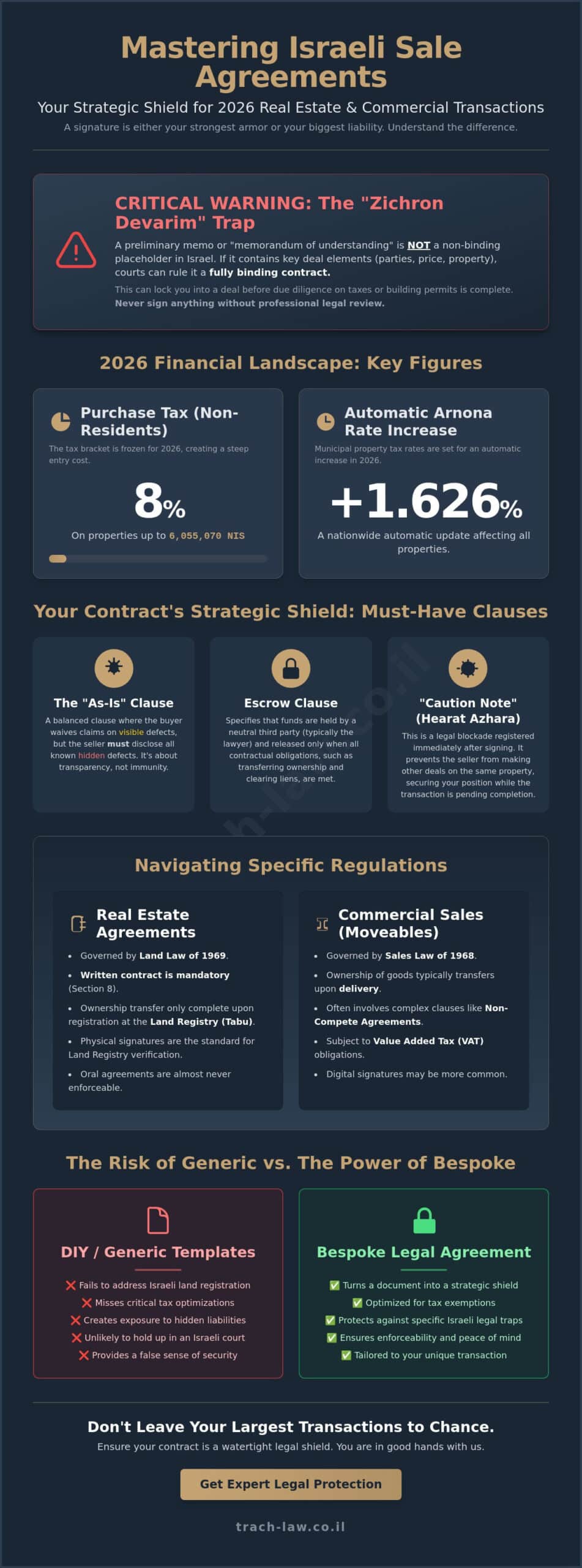
In the Israeli real estate market, a signature on a contract isn't just a formality; it's either your strongest armor or your biggest liability. You're likely aware that a single oversight in Sale agreements can lead to devastating financial consequences, especially with the 2026 purchase tax brackets for non-residents frozen at a steep 8% for properties up to 6,055,070 NIS. It's natural to feel a sense of distrust toward generic templates that fail to address the complexities of Israeli land registration or the 1.626% automatic increase in Arnona rates for 2026.
You are in good hands when you approach these transactions with the right legal strategy. This guide will help you master the intricacies of Israeli contracts to ensure your transaction is legally binding and optimized for tax exemptions. We'll explore the critical clauses you need for 2026, the specific requirements for foreign buyers, and how to avoid the hidden liabilities that often trap the unwary. We'll show you how to turn a standard document into a strategic shield that protects your assets and your future.
Key Takeaways
- Learn why signing a preliminary "Zichron Devarim" can be a dangerous legal trap and how to avoid binding yourself before a full contract is ready.
- Identify the essential "As-Is" and escrow clauses that transform standard Sale agreements into powerful strategic shields for your property or business assets.
- Master the 2026 tax landscape, including frozen purchase tax brackets and capital gains exemptions, to ensure you don't lose money to avoidable levies.
- Distinguish between the specific regulatory requirements for residential real estate and commercial transactions, including non-compete clauses and VAT obligations.
- Understand why bespoke legal adjustments are the only way to ensure your contract holds up in an Israeli court and provides true peace of mind.
Understanding Sale Agreements in the Israeli Legal Context
In the Israeli legal system, a contract is more than just a mutual understanding; it's the definitive mechanism that transfers rights from one party to another. While a global Purchase and Sale Agreement (PSA) provides a baseline for commercial logic, Israeli Sale agreements are strictly governed by the Land Law of 1969 and the Sales Law of 1968. These statutes dictate that the transfer of real estate is not complete until it's registered in the official records. You aren't just buying a property; you're acquiring a registered right that must be defended through precise legal drafting.
You must be wary of the "Zichron Devarim" trap. Many buyers and sellers mistakenly believe that a preliminary memo or a "memorandum of understanding" is a non-binding placeholder. In Israel, if this document contains the essential elements of the deal, such as the names of the parties, the price, and the property description, a court will likely rule it as a fully binding contract. This can lock you into a transaction before you've performed due diligence on tax liabilities or building permits. You should never sign any document, no matter how informal it seems, without professional legal review.
Israeli law also draws a sharp line between moveables and real estate. Under the Sales Law, ownership of moveable goods like vehicles or equipment usually transfers upon delivery. Real estate transactions are different. They require a written document and a multi-stage registration process. Without a formal, written agreement, your claim to a property is virtually non-existent in the eyes of the law.
The Role of the Land Registry (Tabu)
The Land Registry, commonly known as the "Tabu," is the central authority for property rights. When you enter a transaction, your lawyer must first verify the property's status to ensure it's free of liens or third-party claims. Once the contract is signed, the immediate priority is registering a "Caution Note" (Hearat Azhara). This note acts as a legal blockade, preventing the seller from making any other deals on the property while your transaction is pending. It's important to distinguish between the Tabu, the Israel Land Authority (Rami), and private housing companies, as each has different registration requirements. The Tabu is the ultimate proof of ownership in Israel.
Legally Binding Requirements in 2026
For a sale agreement to hold up in an Israeli court in 2026, it must meet specific criteria. It needs clear identification of the parties, a definitive price, a detailed description of the asset, and the signatures of all involved. While digital signatures have gained traction in general commercial law, real estate Sale agreements still typically require physical signatures verified by a lawyer to meet Land Registry standards. Oral agreements in real estate are almost never enforceable due to Section 8 of the Land Law, which mandates a written document. You can find expert support for these complex procedures through our ליווי עסקאות מקרקעין services.
To ensure your interests are fully protected and your transaction is legally watertight, it's vital to have an expert by your side. You're in good hands with us. Reach out to עמנואל טראץ', עורך דין ונוטריון today for professional legal guidance tailored to your specific needs.
Essential Clauses Every Protective Sale Agreement Must Include
A well-drafted contract serves as your primary defense against the unpredictable nature of high-stakes transactions. While the previous section focused on the registration and legal framework, the actual strength of Sale agreements lies in the specific clauses that dictate how risks are allocated between the parties. You shouldn't view these clauses as mere boilerplate text; they're the tactical instructions that protect your capital and your peace of mind. Every word must be measured to ensure that if a dispute arises, the contract provides a clear, enforceable path to resolution.
The "As-Is" clause is one of the most misunderstood components in Israeli law. Sellers often believe it grants them total immunity from future claims, while buyers fear it leaves them completely exposed. In reality, a protective agreement balances this. The buyer declares they've inspected the property and waive claims regarding "visible" defects, but the seller remains legally obligated to disclose any "hidden" defects they're aware of. This transparency is rooted in the principle of good faith, a cornerstone of the Israeli legal system that's reinforced by the spirit of Israel's Basic Laws. If a seller knowingly hides a structural flaw, an "As-Is" clause won't shield them from liability.
Representations and warranties further define the boundaries of the deal. The seller must explicitly state that the property is free from third-party rights, legal proceedings, or building violations. If these representations prove false, it often triggers a "Fundamental Breach," allowing the injured party to cancel the deal and claim damages without proving actual loss. Ensuring these details are accurate is why you need a professional to review your specific situation before signing.
Escrow and Fund Protection
Safe fund management is the heartbeat of a secure transaction. In Israel, the buyer doesn't simply hand over the full purchase price to the seller. Instead, a significant portion of the final payment is held in a dedicated escrow account managed by the buyer's lawyer. These funds are only released once the seller provides all necessary "Tax Confirmations," including proof that Capital Gains Tax (Mas Shevach) and municipal taxes have been paid in full. This mechanism ensures the buyer isn't left responsible for the seller's outstanding debts to the authorities.
Default and Compensation Mechanisms
Standard Israeli Sale agreements typically include a liquidated damages clause set at 10% of the purchase price. This amount is payable by the breaching party in the event of a fundamental breach, such as a refusal to transfer rights or a failure to make payments on time. It's also vital to define "Force Majeure" clearly. Given the unique security climate in Israel, your contract should specify how delays caused by military operations or national emergencies affect the timeline, ensuring that neither party is unfairly penalized for circumstances beyond their control.
To ensure your interests are fully protected and your transaction is legally watertight, it's vital to have an expert by your side. You're in good hands with us. Reach out to Lawyer Emanuel Tratch (עורך דין עמנואל טראץ) today for professional legal guidance tailored to your specific needs.
Real Estate vs. Commercial Sales: Navigating Specific Regulations
The regulatory landscape in Israel shifts dramatically depending on whether you're transferring a physical property or a business entity. You can't treat these two transactions the same way. While the foundational logic of Sale agreements remains consistent, the specific risks and tax liabilities vary. Real estate is largely a battle against bureaucratic registration and land taxes, whereas commercial sales focus on the transfer of intellectual property, non-compete clauses, and complex VAT (Maam) arrangements. Understanding these nuances is a key part of Doing Business in Israel safely.
Commercial transactions often involve unique considerations for those operating in the security sector. If you're a Ministry of Defense (MoD) supplier or involved in defense exports, your agreement must account for security clearances and the specific regulations of the Defense Export Control Agency (API). A standard contract won't protect you if it fails to address the "protective shield" required for these sensitive assets. You need a lawyer who understands the intersection of civil law and security requirements to ensure your business remains compliant and your assets remain secure.
Tax Implications of Property Sales
Real estate transactions are heavily influenced by the 2026 tax environment. Sellers must navigate Capital Gains Tax (Mas Shevach), which is generally 25% on the real gain after adjusting for inflation. However, Israeli residents may qualify for exemptions if the property is their only residence and the sale price is below 5,008,000 NIS in 2026. Buyers must also account for Purchase Tax (Mas Rechisha). For 2026, the brackets for foreign residents are frozen, with an 8% rate on property values up to 6,055,070 NIS. You should also be aware of the Betterment Levy (Heitel Hashbacha), a municipal tax triggered by changes in building rights. For comprehensive support in these areas, you can learn more about real estate legal services here.
Sale Agreements for Inherited Assets
Selling a property that's part of an estate introduces significant legal hurdles. You cannot legally sign Sale agreements for an inherited asset until you possess a valid "Succession Order" (Tzav Yerusha) or a "Probate Order" (Tzav Kiyum Tzavaah). These documents are the only legal proof of ownership for heirs. If multiple heirs are involved, the contract must be carefully structured to reflect the consent and signature of every party to avoid future litigation. You can find detailed guidance on Inheritance and Succession Orders to help you navigate this sensitive process.
To ensure your interests are fully protected and your transaction is legally watertight, it's vital to have an expert by your side. You're in good hands with us. Reach out to Lawyer Emanuel Tratch (עורך דין עמנואל טראץ) today for professional legal guidance tailored to your specific needs.
The Risks of DIY Templates and How to Mitigate Them
The allure of a free online template is understandable, but in the Israeli legal arena, a generic document is a dangerous gamble. You might save a few thousand shekels upfront, yet you risk losing millions if the contract fails to account for specific 2026 regulations. Many people believe they can simply download a "standard" form, but they often overlook that Sale agreements must be tailored to the exact tax status of the parties and the specific history of the asset. A template won't alert you to an outstanding mortgage from 1998 or warn you about the 18% VAT applicable to professional fees and commercial deals. It certainly won't help you navigate the frozen purchase tax brackets that currently affect non-resident buyers.
Bespoke adjustments are the only way to ensure your deal is watertight. Every transaction has unique variables, from the presence of protected tenants to complex land ownership structures where only 7% of Israeli land is privately owned. You shouldn't settle for a "one size fits all" solution when your life savings are on the line. While you might worry that legal fees are expensive, the cost of a lawsuit in an Israeli court is far higher. A failed deal can lead to years of litigation, liquidated damages of 10% of the purchase price, and the total loss of your deposit. Investing in a professional contract is a small price for a protective shield that secures your future.
Due Diligence Beyond the Document
A document alone cannot perform due diligence. You need a professional to verify that the physical structure matches the building permits on file at the local municipality. Illegal construction is a common issue, and buying a property with unpermitted additions can lead to demolition orders or heavy fines. Verifying the seller's identity is equally critical to preventing sophisticated fraud schemes. This is why criminal legal expertise matters in fraud prevention; we understand how to spot the red flags of identity theft and forged documents before you transfer a single shekel. To ensure your deal is safe from the start, contact us for a full due diligence review.
The Role of Notarization and Power of Attorney
For international buyers or sellers, notary services are indispensable for verifying signatures across borders. In most transactions, you'll need to sign an irrevocable Power of Attorney. This document allows your lawyer to perform essential actions at the Land Registry and tax offices on your behalf, even if you aren't physically present in Israel. A Power of Attorney is the engine that drives the sale to completion.
To ensure your interests are fully protected and your transaction is legally watertight, it's vital to have an expert by your side. You're in good hands with us. Reach out to Lawyer Emanuel Tratch (עורך דין עמנואל טראץ) today for professional legal guidance tailored to your specific needs.
Securing Your Transaction with Emanuel Trach Law Office
Navigating the Israeli legal system requires more than just a signature; it demands a strategic defender who understands the hidden gears of the state. At Emanuel Trach Law Office, we don't just process paperwork. We provide a "protective shield" for your capital and your future. Our firm's expertise isn't limited to the civil world. We bring a unique perspective forged at the intersection of military, criminal, and civil law. This background allows us to anticipate risks that traditional real estate lawyers often miss, from subtle fraud indicators to complex regulatory hurdles involving the security sector. We manage the entire arc of your transaction, ensuring that from the first negotiation to the final Tabu registration, your interests are guarded with absolute discretion and professional authority.
Asset protection in Israel is a high-stakes mission. Whether you're dealing with a residential property or a commercial entity, the legal environment of 2026 demands a level of precision that generic services cannot provide. We understand the pressure of moving large sums of money through rigid systems. Our role is to act as the responsible adult in the room, navigating the bureaucracy so you don't have to. We ensure that every clause in your Sale agreements is vetted against current tax laws and municipal requirements, providing you with the peace of mind that only comes from knowing your deal is legally watertight.
Bespoke Drafting for Complex Deals
Not every transaction fits into a standard box. We specialize in tailoring agreements for Ministry of Defense (MoD) suppliers and businesses that require a deep understanding of security-related regulations. If your deal involves defense exports or specific security clearances, a standard contract is a liability. We also provide dedicated support for foreign residents and those navigating complex migrant status issues. We ensure that your status doesn't become a barrier to a successful transaction. To start building your protective legal strategy, contact us for a consultation and let us handle the complexities for you.
You Are in Good Hands
Our philosophy is built on proactive defense. We solve problems before they arise by conducting exhaustive due diligence and maintaining a sharp focus on the details. We're committed to providing national-level service for all Israeli residents, treating every client with the seriousness and dedication they deserve. When you prepare for your first meeting with us, bring all relevant property documents, identification, and any preliminary correspondence. We'll take it from there, transforming your Sale agreements into a secure foundation for your investment.
To ensure your interests are fully protected and your transaction is legally watertight, it's vital to have an expert by your side. You're in good hands with us. Reach out to Lawyer Emanuel Tratch (עורך דין עמנואל טראץ) today for professional legal guidance tailored to your specific needs.
Take Control of Your Assets in the Israeli Market
Success in the 2026 property market depends on your ability to outpace bureaucratic risks and tax liabilities. You've seen how precise registration at the Land Registry and the strategic use of escrow accounts prevent financial loss. Whether you're navigating the complexities of inherited estates or high-stakes commercial deals, the details in your Sale agreements are what stand between you and years of costly litigation. Don't leave your life savings to the mercy of a generic template when you can have a bespoke protective shield.
Our firm provides a unique advantage by combining over 10 years of experience in complex Israeli litigation with deep expertise in both civil and military legal systems. We understand the sensitivity of your assets and the need for absolute discretion. You can move forward with confidence knowing that every legal angle is covered. Protect your assets with a professional Sale Agreement—Contact Emanuel Trach Law Office today. Your future security is worth the investment in professional due diligence.
To ensure your interests are fully protected and your transaction is legally watertight, it's vital to have an expert by your side. You're in good hands with us. Reach out to Lawyer Emanuel Tratch (עורך דין עמנואל טראץ) today for professional legal guidance tailored to your specific needs.
Frequently Asked Questions
Is a sale agreement legally binding if it is not notarized in Israel?
A sale agreement is legally binding in Israel once signed by both parties even without a notary's stamp. While real estate transactions must be in writing to satisfy Section 8 of the Land Law, it's the verification by a qualified lawyer that usually suffices for the Land Registry. You only require a notary for an irrevocable Power of Attorney or when signing documents outside of Israel to ensure they're recognized by authorities.
What is the standard penalty for backing out of a sale agreement?
The standard penalty for backing out of a contract is typically 10% of the total purchase price. This amount is defined as liquidated damages for a fundamental breach. It allows the injured party to receive compensation without having to prove the exact financial loss in court. You must ensure this clause is explicitly stated in Sale agreements to provide a clear protective shield if the other party fails to perform.
How does capital gains tax (Mas Shevach) affect a sale agreement in 2026?
In 2026, Capital Gains Tax is generally set at 25% of the real gain after adjusting for inflation. Israeli residents selling their only home may qualify for a full exemption if the sale price remains below 5,008,000 NIS. Foreign residents are typically excluded from this benefit. Precise tax planning within the contract is vital to avoid losing a significant percentage of your assets to the tax authorities unexpectedly.
Can I sign a sale agreement while living abroad?
You can absolutely sign a sale agreement while living abroad by using an irrevocable Power of Attorney. This document must be signed in front of an Israeli consul or a local notary and then legalized with an Apostille stamp. This allows your lawyer in Israel to act as the engine driving the transaction to completion without requiring your physical presence for every technical stage at the Land Registry or tax offices.
What is the difference between a Bill of Sale and a Sale Agreement in Israel?
A Sale Agreement is the comprehensive contract detailing all terms, while a Bill of Sale (Shtar Mecher) is the specific registration document. The agreement governs the relationship, payments, and warranties between the buyer and seller. In contrast, the Bill of Sale is a short, technical form required by the Tabu to officially transfer the title. Both are essential, but the agreement provides the legal armor that protects your interests.
What happens to a sale agreement if the seller passes away before closing?
If a seller passes away before closing, Sale agreements remain legally binding on their estate and heirs. The transaction process usually pauses until the heirs obtain a Succession Order or Probate Order from the Inheritance Registrar. Once these documents are issued, the heirs step into the seller's shoes to fulfill the contractual obligations. This highlights why verifying the status of all parties is a critical part of due diligence.
To ensure your interests are fully protected and your transaction is legally watertight, it's vital to have an expert by your side. You're in good hands with us. Reach out to עמנואל טראץ', עורך דין ונוטריון today for professional legal guidance tailored to your specific needs.

Article by
עמנואל טראץ', עו"ד ונוטריון
עו"ד ונוטריון עמנואל טראץ', עורך דין בעל ניסיון עשיר, חבר בלשכת עורכי הדין החל משנת 2011.
עורך דין פרטי ותיק, בעברו שימש כיועץ משפטי בחטיבה להתאמה ביטחונית בשב"כ (סיווג ביטחוני) ויועץ משפטי בתחום הפלילי והמנהלי. פועל בשוק הפרטי משנת 2013, ומייצג לקוחות פרטיים ותאגידים. בשירותו הצבאי, שירות כחוקר בכיר וראש צוות חוקרים במצ"ח ביחידה המרכזית לחקירות מיוחדות (ימל"מ).
הבהרה
המידע באתר הוא מידע כללי ואינו מידע מחייב. הזכויות המחייבות נקבעות על-פי חוק, תקנות ופסיקות בתי המשפט. השימוש במידע המופיע באתר אינו תחליף לקבלת ייעוץ או טיפול משפטי, מקצועי או אחר והסתמכות על האמור בו היא באחריות המשתמש בלבד
פנה לקבלת
ייעוץ משפטי ללא התחייבות