
Israeli Security Clearance (Sivug Bitchoni) | Expert Legal Counsel
Navigating the Israeli Security Clearance (Sivug Bitchoni) Process: A Comprehensive Professional Guide
Introduction: The Gateway to Your Career
In the intricate landscape of Israel’s defense, high-tech, and government sectors, the security clearance process—known in Hebrew as Sivug Bitchoni—is often the final gatekeeper between you and your professional aspirations. Whether you are aiming for a position in the defense industry, the intelligence community, or the public sector, obtaining clearance is a critical milestone.
However, the process is far from a mere administrative formality. It is a rigorous, deeply personal, and highly secretive assessment conducted by the Israel Security Agency (ISA), or the Shin Bet. A misstep in an application or an improperly framed answer during an interview can result in a security rejection (Psila Bitchonit), potentially halting your career trajectory for years.
This guide is designed to demystify the security clearance process. By understanding the methodology, the legal framework, and the strategic importance of preparation, you can approach your clearance interview with confidence rather than apprehension.
The Legal Framework: Why the ISA Conducts Clearances
The authority for security clearances is anchored in the General Security Service Law (ISA Law, 2002). This law mandates the agency to protect state secrets and maintain national security. When you undergo the Sivug Bitchoni process, you are not simply being vetted for a specific job; you are being profiled for loyalty, reliability, and security integrity.
It is vital to understand that the state views this as a “security assessment,” not a job interview in the traditional sense. The investigators are tasked with identifying potential risks—be they ideological, financial, or behavioral—that could make an individual vulnerable to external influence or compromise.
Understanding the Classification Levels
Israel employs a tiered system for security clearances, typically ranging from levels 1 to 6.
-
Levels 1-3: Reserved for positions involving highly sensitive, strategic information. These clearances require exhaustive background checks, deep-dive interviews, and frequent monitoring.
-
Levels 4-6: Generally for roles involving sensitive but less critical information. While less intensive than level 1, these still require a comprehensive assessment of your personal and professional history.
Regardless of the level, the core principles of truthfulness and consistency remain identical.
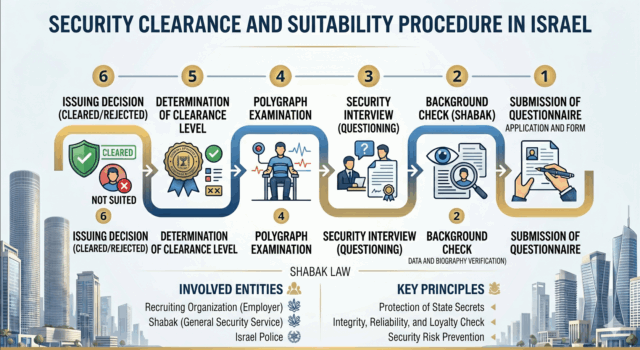
process Israeli Security Clearance
The Three Pillars of the Clearance Process
1. The Questionnaire (The First Line of Defense)
The process begins with an extensive questionnaire. Many candidates treat this as a simple form-filling exercise, which is a significant strategic error. The information you provide is cross-referenced with government databases, intelligence archives, and public records.
-
The Trap of Inconsistency: Discrepancies between your current answers and past records can be flagged as intentional deception.
-
The “Red Flags”: Connections to certain countries, unusual financial activities, or past brushes with the law must be disclosed correctly.
-
Legal Preparation: Before submitting, it is often wise to consult with an expert who can help you identify areas that need clarification or context to ensure the form accurately reflects your life without creating unnecessary alarm.
2. The Security Interview (The “Tathkir”)
This is the heart of the clearance process. You will sit before a trained interviewer (a Metacheker) whose sole job is to assess the “person behind the paper.”
-
What they are looking for: Beyond your answers, they are observing your reactions, your emotional state, and your consistency.
-
The Risk of Over-sharing: While honesty is mandatory, “over-sharing” information that is irrelevant or easily misinterpreted can damage your case.
-
Preparation: Effective coaching involves learning how to provide direct, relevant, and calm responses. You are not “rehearsing lines”; you are learning how to articulate your history clearly and professionally.
3. The Polygraph (The Physiological Assessment)
Not every clearance involves a polygraph, but when it does, it is the most stressful stage. The polygraph is a tool to measure physiological responses to specific stress-inducing questions.
-
The Reality of the Test: The polygraph is not perfect; it is sensitive to anxiety.
-
Strategic Approach: We provide clients with a clear understanding of the procedure, how to manage nervous tension, and how to remain focused throughout the testing session.

Israeli Security Clearance
Dealing with a Security Rejection (Psila Bitchonit)
Receiving a notice of rejection is a challenging experience, but it is rarely the end of the road. In many instances, the rejection stems from a lack of clarity, a misunderstanding of a specific life event, or a failure to provide proper context during the interview.
-
The 30-Day Window: You typically have 30 days to file an appeal (Irur). This is a strict administrative deadline.
-
Legal Advocacy: An appeal must be a professional legal document that challenges the administrative basis of the rejection. We specialize in synthesizing the facts, gathering necessary character references, and presenting a compelling legal argument to the appeals committee.
Why Strategic Legal Counsel Matters
You might ask, “If I have nothing to hide, do I need a lawyer?” The answer is that the clearance process is not about “hiding” secrets; it is about managing risk.
As a former legal advisor within the ISA system, I understand the logic used by the investigators. My role is to:
-
Protect Your Information: Ensure that the information disclosed in the interview does not inadvertently trigger separate investigations (disciplinary or otherwise).
-
Mitigate Risks: Help you present your history in the most transparent and contextually accurate light.
-
Provide a Safety Net: If the process hits a snag, you have a professional advocate who understands the administrative protocols of the system.
Comprehensive Professional Support
Our office provides a “360-degree” approach to security and professional integrity. Beyond standard security clearances, we assist with:
-
State Service Discipline: Defending public sector employees in disciplinary hearings where clearance status is on the line.
-
Defense Industry Compliance: Assisting companies in becoming certified ministry-of-defense suppliers.
-
Firearms Licensing: Challenging rejections from the Firearms Licensing Department when they are based on security profiling.
Frequently Asked Questions (FAQ)
1. Can I have a lawyer present during the security interview?
No, the interview itself is conducted privately between you and the investigator. However, consulting with a lawyer before the interview is permitted and highly recommended.
2. How long does a security rejection stay on my record?
A rejection is not a lifetime ban, but it creates a “black mark” that can persist for years. However, with successful appeals and the passage of time, these records can be managed.
3. Does having dual citizenship automatically disqualify me?
No. Dual citizenship is common. However, it requires a specific, honest explanation of your ties to those countries and how you prioritize your loyalties.
4. What if I forgot to mention a minor incident from 10 years ago?
The ISA values consistency. If you realize you made an error, there are ways to clarify the record, but this should be handled professionally and proactively before the system flags it as an “attempt to mislead.”
5. Is the appeal process successful?
Many appeals succeed when they are based on legitimate administrative errors or when the candidate provides the context that was missing during the original assessment.
6. Can my clearance be revoked after I already have it?
Yes. Clearances are subject to periodic review. Significant life changes (major debts, foreign marriages, sudden lifestyle shifts) can trigger a re-evaluation.
7. Does an appeal hurt my future chances?
Filing a professional, respectful, and well-reasoned appeal demonstrates that you understand the process and are serious about your professional standing.
8. How can you help me if I have a “checkered” past?
We do not change the facts of your past. We work to ensure that your past is presented with the correct context, legal validity, and honesty required by the system.
Conclusion: Take Control of Your Future
The Sivug Bitchoni process is a rigorous test of integrity and clarity. It is designed to be difficult, but it is not arbitrary. With expert guidance and a structured approach, you can navigate these challenges effectively.
Your career, your professional goals, and your future in Israel’s most prestigious industries are worth protecting. Do not leave your clearance to chance.
Contact our office today for a confidential consultation.
Professional Contact Details
Advocate Emanuel Trach
-
Phone: 055-2550011
-
Email: Emanuel@Trach-law.co.il
-
Office Address: 94 Igal Alon St., Tel Aviv, Alon Tower 2, 4th Floor.
Security Clearance|Sivug Bitchoni|ISA Clearance|Shin Bet Interview|Polygraph Preparation|Security Rejection|Psila Bitchonit|Defense Industry Employment|Israeli Legal Counsel|Administrative Appeal|Government Security Clearance|Background Investigation Israel|High-Tech Security Clearance|Advocate Emanuel Trach|National Security Integrity
שאלון סיווג ביטחוני רמות 1-4, עורך דין עמנואל טראץ by emanuel.trach
Contact for
Legal advice without obligation